Stay curious in the age of AI, TikTok chief Chew Shou Zi tells NTU PhD graduates
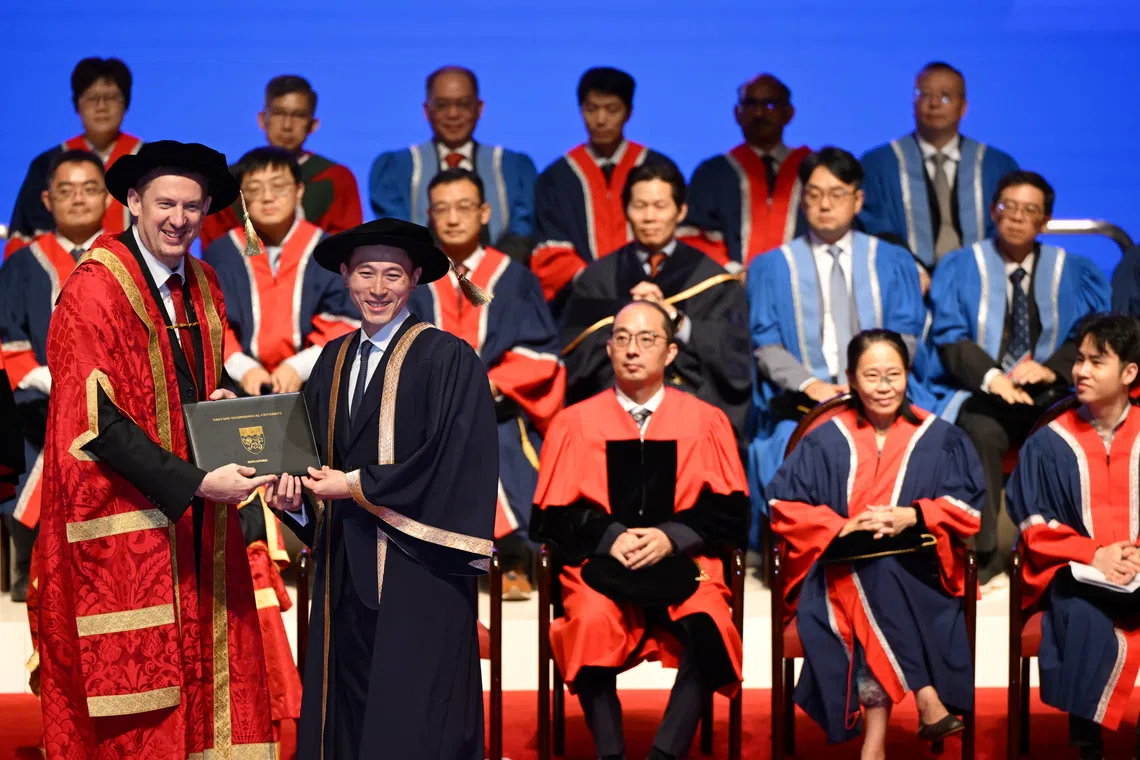
TikTok CEO Chew Shou Zi receiving a certificate of appreciation from NTU Deputy President and Provost Professor Christian Wolfrum at the conferment ceremony on Aug 1.
SINGAPORE – Hours spent playing computer games as a boy fuelled his curiosity about technology that eventually led Chew Shou Zi to become TikTok chief executive.
In a speech to Nanyang Technological University (NTU) PhD graduates on Aug 1, the Singaporean said he built his career on this curiosity, and the belief that impact often means doing things differently from what everyone expects.
Chew, 43, who was born in Singapore in 1983, said these ideas started early in life, with countless hours spent on a computer his father bought when he was a child.
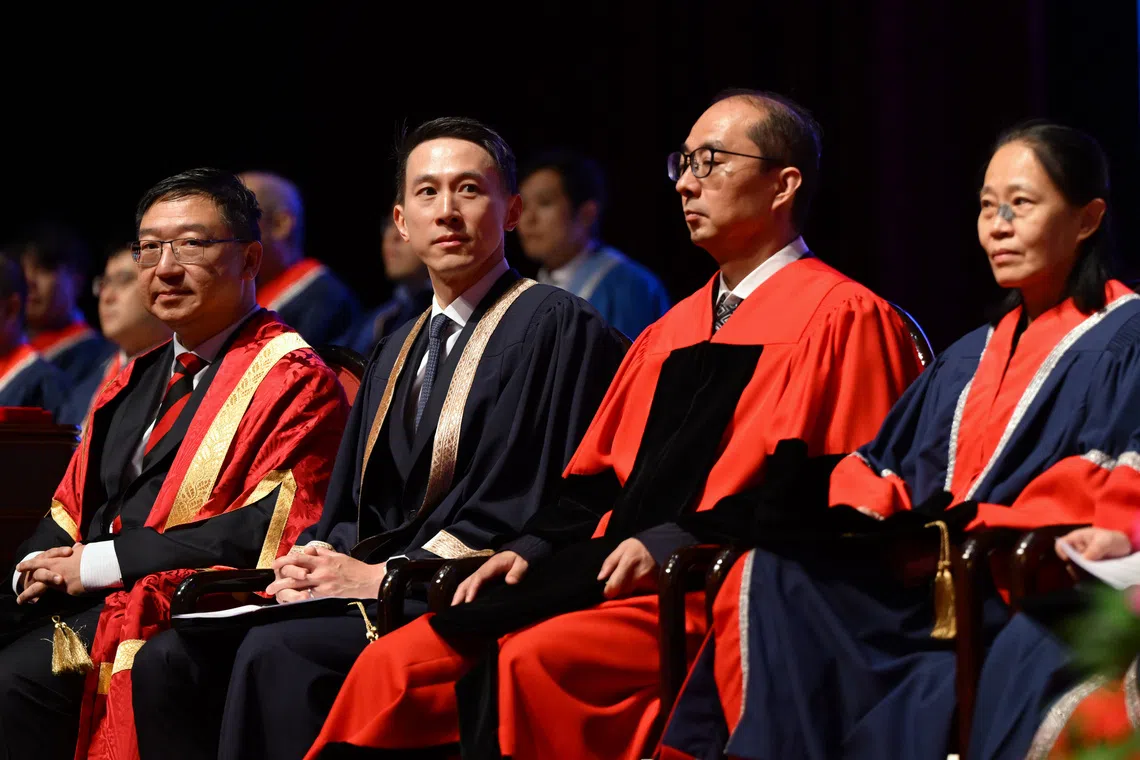
He was speaking at the first of two ceremonies at which 575 graduates received doctorates. They are part of the largest batch of graduates in NTU’s history numbering over 14,000 who will graduate in 29 ceremonies this year.
Said Chew: “I would love to tell you that I was using the computer to code some brilliant software and building the future, but the reality is I was playing computer games. A lot of them.”
He told the graduates he later left his keyboard and Singapore to study economics at University College London, and worked at investment bank Goldman Sachs. He then went to Harvard Business School for a master of business administration.
It was while he was in finance that he found himself watching a massive shift as major investments began pouring into innovative new ideas and tech start-ups, he said.
“Over time, that pull I felt towards technology when I was younger kept resurfacing, and that’s the beautiful thing about genuine curiosity – it’s incredibly resilient,” he said. He followed this pull and left finance, moving into tech.
In 2015, he became chief financial officer of Chinese smartphone giant Xiaomi. He later moved to ByteDance, TikTok’s parent company, and has helmed TikTok since 2021.
Chew urged the graduates to keep their curiosity alive as artificial intelligence reshaped the workforce they will enter, like the digital transformation did when he was launching his career.
Massive change happening
He noted they were leaving school in a period of massive structural change.
He said: “We see it every single day, and an unprecedented, big-picture innovation era. This is a pivotal and exciting point in history – where change is not constant, but exponential and compounding.”
In the face of this, they should actively seek out the unknown and apply their knowledge to the messy, ambiguous problems of the real world, he said.
He added: “Seek out rooms where you are the least experienced person in them. Embrace uncertainty because that is where meaningful innovation happens.”
Chew made international headlines in 2024 after appearing at a US congressional hearing focused on safety for children on social media platforms.
He faced questions on TikTok’s Chinese origins and was also asked if he was affiliated to the Communist Party of China (CPC). Then, he answered with a line which later went viral on social media: “Senator, I am Singaporean. No.”
[[nid:669520]]
Chew on Aug 1 also reflected on growing up in Singapore, and said education was a lifelong passport that opened up his world from his childhood in Yio Chu Kang.
He said his world in primary school was “hyperlocal” and did not extend much further than his neighbourhood.
But getting into Hwa Chong Institution in Bukit Timah after the PSLE expanded his world and pushed him out of his comfort zone, he said.
It was that leap which sparked the intellectual curiosity which showed him that his potential could be as limitless as his imagination, he said.
“In many ways, this is the same story of Singapore itself,” Chew said.
He said the small island nation has, through curiosity and resilience, always looked outward and upward, and has created an outsized global footprint.
He said: “Now today, your global footprint expands too.”
Graduates now have the ‘passport’ to look beyond the walls of the institution and take their work to the world stage, he added.
He said: “You are graduating with deep, specialised academic experience, and with the passion and preparation to challenge the status quo.”