A self-radicalised 14-year-old planned a mass-casualty stabbing attack at his secondary school, drafted a 21-page manifesto and intended to livestream the violence before taking his own life.
He is the youngest person ever detained under Singapore's Internal Security Act (ISA).
The teen was arrested in May, about a month before he planned to launch the attack during the June school holidays, the Ministry of Home Affairs (MHA) said on Monday (July 27).
His case was one of three youth radicalisation cases announced by the authorities. The other detainees were a 15-year-old ISIS supporter who aspired to establish a violent "Malaya Caliphate" in Southeast Asia and a 19-year-old who allegedly plotted attacks against SAF personnel and LGBTQ students.
All three individuals, aged 14, 15 and 19, were self-radicalised online by violent extremist ideologies and had planned to conduct attacks in Singapore.
The 14-year-old non-Chinese Secondary Two student had planned on conducting a mass-casualty stabbing attack at his school during the June holidays.
His arrest was timely - in May, weeks before he intended to attack, Coordinating Minister for National Security K Shanmugam told media on Monday.
"He wrote out a... 21-page attack manifesto," Senior Minister Shanmugam said.
"It set out attack plans, choice of weapons, attack targets: non-Muslim teachers and students in his school.
"[He was] quite serious, and quite advanced in his plans. He was going to livestream his attack, pledge allegiance to ISIS, and then take his own life."
Following his arrest in May, he told the Internal Security Department (ISD) that he would have executed his attack were he not arrested.
How he became radicalised
According to MHA, the teen's radicalisation began in 2024 with first-person shooter games on online gaming platform Roblox that recreated versions of real-life school shootings.
Intrigued, he began researching on these incidents and learnt that several mass shooters had been victims of bullying.
The teen identified with them, claiming that he too had been bullied, and came to view their acts of violence as retaliation against those who had wronged them.
He also consumed violent gore and mass shooting content via social media, aided by algorithms that recommended similar content to him.
Among those the teen idolised was Omar Mateen, the gunman behind the 2016 mass shooting at a gay nightclub in Florida. The youth came to believe it was justifiable to kill gay people, whom he considered haram (forbidden) in Islam.
The teen also shared ISIS content with his schoolmates, none of whom were radicalised.
Planning the attack
Late 2025 saw the teen dealing with stress from academia and his teachers, as well as from being bullied by schoolmates.
He then formulated a plan to attack non-Muslim teachers and students during the June holidays, believing there would be fewer teachers present to stop him.
He identified days when both he and his intended targets would be in school for co-curricular activities.
The youth initially wanted to use firearms but concluded that Singapore's strict gun laws made that unrealistic. He next considered using homemade bombs and knives.
"These bombs and knife will be the closest thing I can ever get to a weapon," he wrote in his 21-page manifesto. "Better than nothing, right?"
He later ditched the plan to use bombs due to the inability to obtain required resources. He settled on using a penknife and a kitchen knife.
"As long as it can get you kills, it is a good enough knife," he wrote.
The kill list
The 14-year-old's manifesto, titled "A Call to Action", contained a list of intended victims of his attack, although no names were disclosed.
He targeted fellow Secondary Two students, particularly girls and some boys, whom he said had "pissed [him] off throughout" his time in school.
Teachers were his primary targets because they had "made his life a living hell", he wrote.
"Last but not least, myself," he wrote. "I will go through the pain of my victims unwillingly and die a martyr, willing to be remembered."
Secondary One students were not "worthy of his wrath", while seniors were mostly unknown to him and had treated him well, the teen also added.
@asiaone Speaking to media with Senior Minister and Coordinating Minister for National Security K. Shanmugam on Monday (July 27) afternoon, Education Minister Desmond Lee said his ministry is working on both education and prevention to help students reject harmful content. #sgnews #Singapore ♬ original sound - AsiaOne
Two other youths detained
Aside from the 14-year-old, a 15-year-old Secondary Four student was self-radicalised with ISIS ideologies and planned to conduct an attack in Singapore for ISIS.
He also intended to establish an Islamic caliphate in Southeast Asia via violence, creating his own flag to represent a "Malaya Caliphate".
The third detainee, 19-year-old tertiary student Tan Jun Jie, was an ISIS supporter who planned knife attacks against Singapore Armed Forces (SAF) personnel at Sembawang Air Base and LGBTQ students at his school.
He also attempted to conduct Distributed Denial-of-Service (DDoS) cyberattacks against Muslim websites he deemed deviant.
Combating extremism a whole-of-society effort
Speaking with media on Monday, SM Shanmugam said that MHA works alongside many other agencies to take action, but they have their limits.
"It's impossible to block everything," he said.
"Tackling harmful, extremist content has to be an effort that everyone is involved in."
In all three cases, the radicalised youths had shared their views with people around them, including family members and friends.
SM Shanmugam stressed that the public and parents must stay vigilant to safeguard their children, noting how quickly radicalisation can take hold.
"That is why it is extremely important to report early, and that allows for intervention early," he said.
Reporting radicalisation in its early stages is important, as it allows for measures such as counselling and rehabilitation instead of detention, he added.
"I really encourage everyone to do your part, our part, to keep Singapore safe."
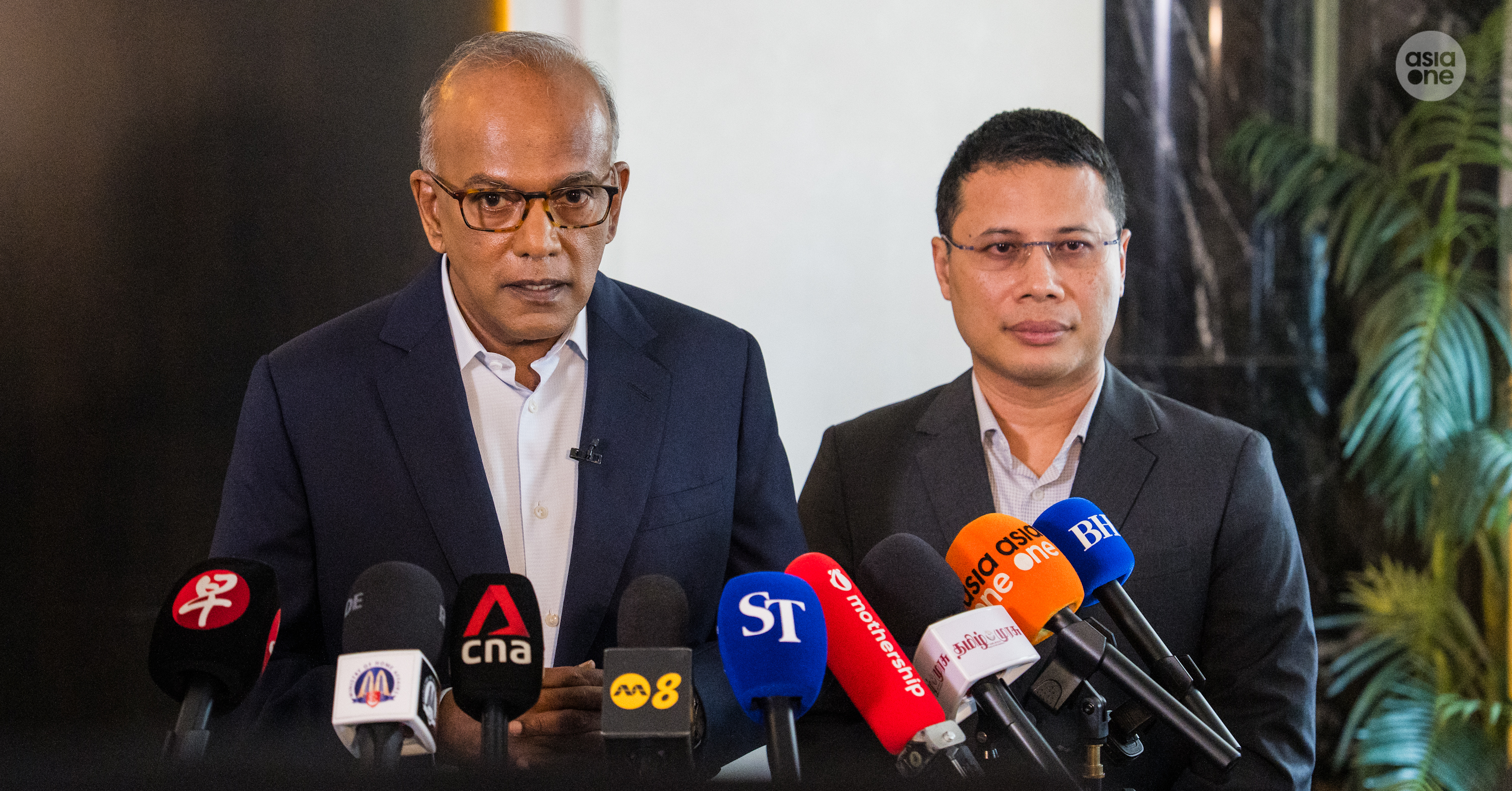
Education Minister Desmond Lee also shared that the Ministry of Education (MOE) is very concerned about the growing number of children and youth being radicalised online.
According to SM Shanmugam, 23 people below the age of 20 have been dealt with under the ISA over the past 11 years.
"While ISD will focus on their rehabilitation, MOE will support their education while they are in detention," Minister Lee said.
"We will work together to try to help them to recover and move on positively and purposefully."
Acknowledging the fears of parents, teachers and students regarding the trend of self-radicalisation, Minister Lee shared that they will be looking at improving their efforts in Character and Citizenship Education across their curriculum.
MOE is also working with ISD to run counter-radicalisation outreach activities, as well as workshops for school staff and peer support leaders to spot warning signs in their students early.
The ministry will also enhance existing emergency response measures to address new and evolving threats, he said.
"Ultimately, as SM Shanmugam said, our strongest defence is this collective vigilance and our preparedness among Singaporeans and also among the school communities," he added.
"We'll continue to work closely with ISD, with our community partners, with parents, with educators to look out for children and young people who may be vulnerable to extremist influence and provide them guidance as well as support."
@asiaone Asked if the cases involving self-radicalised individuals may have an an impact on the Malay community in Singapore, Senior Minister K. Shanmugam pointed out that those who want to do harm are a small minority. He urged Singaporeans not to go down the route of looking at someone else with suspicion based on skin colour, religion, or race. #sgnews #Singapore #Community #Security ♬ original sound - AsiaOne
[[nid:737167]]
[email protected]