While road works are necessary to keep Singapore's roads running, they may not all be for maintenance purposes and could cause disruptions and inconveniences to road users.
Such works take place as contractors carry out exploratory investigations to verify the location of existing utilities before the commencement of construction works.
Acknowledging that such repeated road openings can cause inconvenience to the public and lead to increasing construction costs and extended project timelines, Minister for National Development Chee Hong Tat on Sunday (June 14) announced a new centralised submission portal by the Singapore Land Authority (SLA), which could eventually ease this challenge.
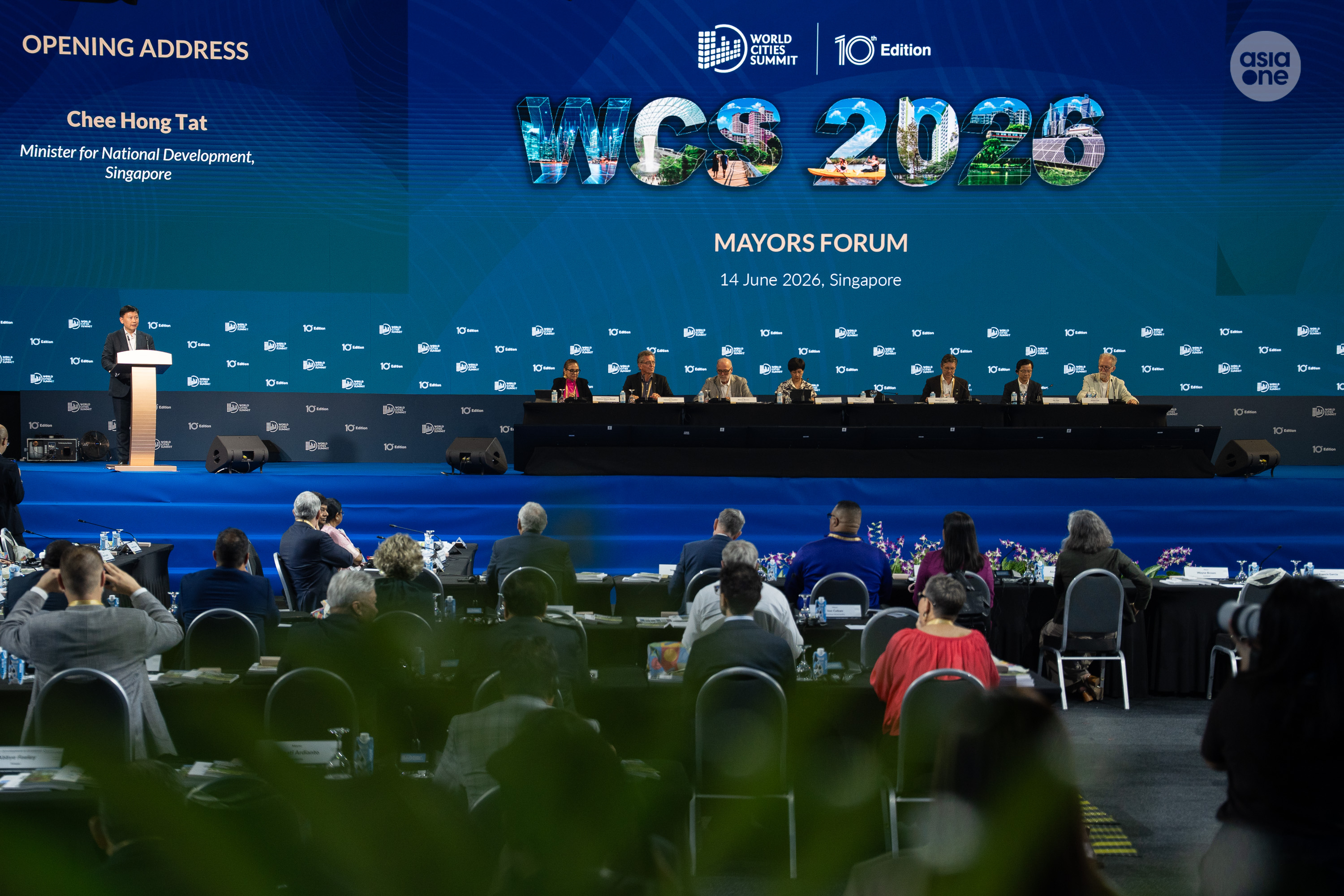
The national development minister was speaking at the World Cities Summit 2026 Mayors Forum held at Suntec Convention and Exhibition Centre.
Coordinating underground infrastructure planning
Explaining the complexities of managing a dense, mature city, Chee said that the existence of a complex and dense network of utility infrastructure beneath the city necessitates careful planning and coordination.
He noted that as different utility owners plan, install and maintain their assets separately, coupled with the fact that underground utility records are maintained across multiple systems, conflicts may arise and are sometimes only discovered during construction works.
This, in turns, leads to delays, additional costs and project disruptions.
To overcome this, contractors would carry out exploratory investigations to verify the location of existing utilities before commencing their works.
This can lead to repeated road openings, causing inconvenience to the public, increasing construction costs and extending project timelines, the national development minister said.
To overcome this, Chee shared that the Urban Redevelopment Authority (URA) implemented the Major Infrastructure Workflow in 2024, enabling lead implementing agencies of major infrastructure projects to do advance planning to identify and resolve potential conflicts with existing utility networks early, before construction begins.
Together with private sector stakeholders, agencies are also adopting engineering solutions such as multi-channel ground penetrating radar, active electromagnetic locators and utility specific ducts.
According to the Ministry of National Development, these solutions give project teams a clearer picture of what lies underground, thereby reducing the need for exploratory digging and improving project efficiency, while minimising disruption to road users.
These efforts have led to the avoidance of about $300 million in unnecessary costs over about 272 kilometres of utility corridors, the national development minister said.
As part of the agencies' efforts to build more reliable underground utility records, Chee announced that the Singapore Land Authority (SLA) is developing a centralised submission portal called the Utility Survey Submission Portal (USSP).

The portal will allow project teams to submit utilities data with locational information after completing works, to build more reliable shared records over time.
It is now being tried out on selected projects and is expected to be scaled up in 2027.
@asiaone Motorists in Singapore would have come across roadworks at the same stretch of road within months, or even weeks. Speaking at the World Cities Summit's Mayors Forum on Sunday (June 14), National Development Minister Chee Hong Tat shed light on why this may be the case, and how URA and SLA are tackling this issue - to save reduce inconveniences for motorists and save on unnecessary costs. #sgnews #Singapore #Cities #Planning #Development ♬ original sound - AsiaOne
About 100 city and regional delegates are expected to attend the summit, now in its 10th run, jointly organised by Singapore's Centre for Liveable Cities and the Urban Redevelopment Authority (URA).
Themed "Liveable and Sustainable Cities: ACT Now!", this year's summit focuses on the need for cities globally to accelerate, collaborate and transform, to create more liveable, resilient and sustainable cities for their residents, now and in the future.
[[nid:737572]]
[email protected]




