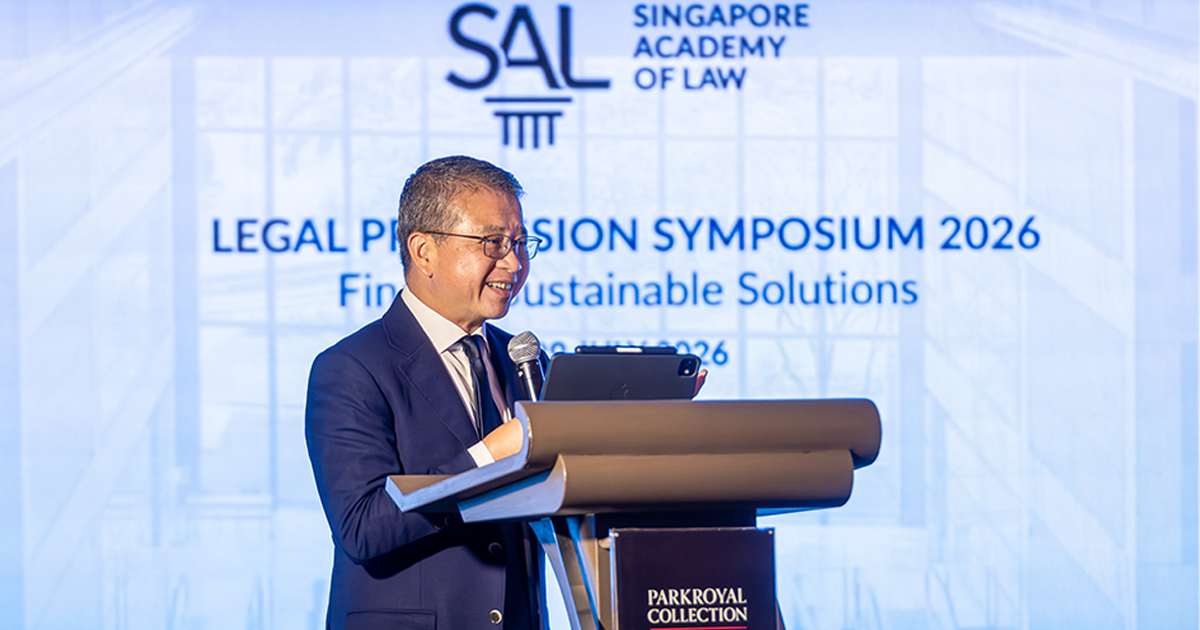
Singapore's legal profession is at a "critical inflection point", with conversations about its future needing to go beyond working hours and salaries to include the purpose and value lawyers find in their work, said Minister for Law Edwin Tong.
Speaking at the closing of the Legal Profession Symposium on Thursday (July 30), Tong said the profession must be clear about what a sustainable legal profession should look like as it grapples with issues ranging from attrition and workplace culture to technological change.
Recalling his conversations with lawyers over the years, the law minister, who spent 25 years in legal practice before entering politics, highlighted the importance of value and purpose in legal work.
"It is important to find value and purpose in the job, in the role, to see yourself as part of a valuable system, part of a chain, and part of an ecosystem that is positive, that contributes to a purpose, to a passion, and to an outcome that you can see yourself part of."
Tong’s remarks come against the backdrop of the recently published Legal Profession Sustainability Report, which spotlighted court deadlines and judicial interactions, a deepening well-being crisis and workplace culture as some of key factors why lawyers are leaving private practice.
The law minister said he welcomed the report, which brought conversations that often took place quietly within the profession into the open.
"That is a good thing. Every strong profession must have the confidence to examine itself honestly — not to assign blame or dwell on the past, but to ask how it can become even better," Tong said.
Tong described the profession as being at a "critical inflection point", citing concerns over the pipeline of talent entering the sector and the long-term sustainability of legal practice.
"In terms of how we see the pipeline of talent coming through, the sustainability of practice, as we understand it to be, and how we would like it to be, we are really at a critical inflection point, and I think it's important for us to really sit up, pay attention," he said.
Turning to the issue of attrition, the law minister noted that retention rates have remained "broadly stable" between 2015 and 2024, with around 60 per cent of lawyers remaining in practice after five years and around 40 per cent after 10 years.
But such trends are not unique to the legal profession.
Citing a Landbase study earlier this year, which found that Gen Z workers are expected to hold up to 17 jobs across seven different careers over their working lives, Tong said the issue is not about whether people are leaving, but why they are leaving.
"I think that distinction matters a lot. If someone discovers that their passion perhaps lies elsewhere, we should wish them well.
"But if talented lawyers are leaving because parts of legal practice have become unnecessarily unattractive or unsustainable, then we need to understand why, and do something about it," he said.
Leaving practice not the same as leaving law
A recent Singapore Academy of Law survey done on 289 newly qualified lawyers found that one in three expected to leave their current firm within the next three years.
Tong pointed out that a closer look at the numbers reveal that only eight respondents, or less than 3 per cent, expressed that they intended to leave the legal profession entirely.
The rest had picked options such as going to another firm, joining the Singapore Legal Service, becoming an in-house counsel, or pursuing careers in academia.
He said that this shows the vast majority of lawyers still wanted careers in law but saw themselves contributing in different ways.
"It reflects the breadth of what a legal education prepares you to do," he added.
The law minister also said that he does not subscribe to the suggestion that lawyers today are afraid of hard work or unable to withstand pressure.
"We all know what it takes to succeed. And I believe today's lawyers, they know that too.
"But there is a world of difference between hard work that builds you up, that strengthens you, that enriches your experience, and hard work that wears you down."
This distinction, he said, is necessary if the profession is to succeed in charting a path that deals with the issues raised in the report.
Way ahead
The law minister set out three focus areas: workforce, workplaces, and work.
On the first area, one idea being explored is bringing education and practice closer together; not to replace classroom learning but to complement it with meaningful, real-world experience before law students enter the profession full-time.
As the Ministry of Law undertakes a broader review of legal education, Tong welcomed initiatives such as the Singapore Academy of Law's Advocacy Pledge 2.0, which provides young lawyers with structured advocacy opportunities, supervision and feedback.
Tong commended the firms that have stepped forward and urged more to consider doing the same.
Turning to workplace culture, he said that good supervision and mentorship matter.
"Nothing excuses poor supervision, inadequate training, harassment, bullying, or the unreasonable treatment of lawyers.
"Being screamed at or ridiculed, being expected to work unreasonably is simply not acceptable," he said, adding that workplaces can be demanding, but without being demeaning.
"Feedback can be candid without being disrespectful."
Another area he felt strongly about is mentorship.
Calling it a professional obligation, Tong said that no amount of additional time in practice training will make a meaningful difference unless those who are entrusted with the training of young lawyers take a genuine interest and a personal investment in them.
"Mentoring, like advocacy and client counselling, is a skill that needs to be learnt and strengthened."
On the work front, Tong announced that the Future of the Legal Profession Committee will establish the Singapore Council on AI for Legal Excellence (SCALE).
The council will bring together leaders from across the profession, academia, technology companies, in-house practice and the public sector.
Its work will focus on three areas: understanding how artificial intelligence (AI) is reshaping legal work, jobs and skills; strengthening AI education and training; and examining how AI is changing law firm structures and business models.
"The objective is straightforward: to build a clearer, evidence-based understanding of what is changing, and then working out what our response should be to these changes," the law minister said.
[[nid:734011]]
[email protected]