SINGAPORE - The full Economic Strategy Review Final Report was released on Wednesday (June 24), with further details of the 32 recommendations that were released with an executive summary on May 13.
These include specific new proposals such as reviewing Singapore’s taxation framework to help startups attract foreign talent, and expanding the SkillsFuture Jobseeker Support Scheme to cover more workers.
The government will study the recommendations and work with industry partners and unions to translate them into action, the Ministry of Digital Development and Information said in a statement.
The report sets out the country’s strategy to secure growth and create good jobs for Singaporeans in a “fundamentally changed global environment”.
Its 32 recommendations fall across eight focus areas – four aimed at securing economic growth, three at creating good jobs and one on resilience.
Seven recommendations were first unveiled in January at the ESR’s midterm update, before the full slate was presented at the Singapore Business Federation’s Future Economy Conference in May.
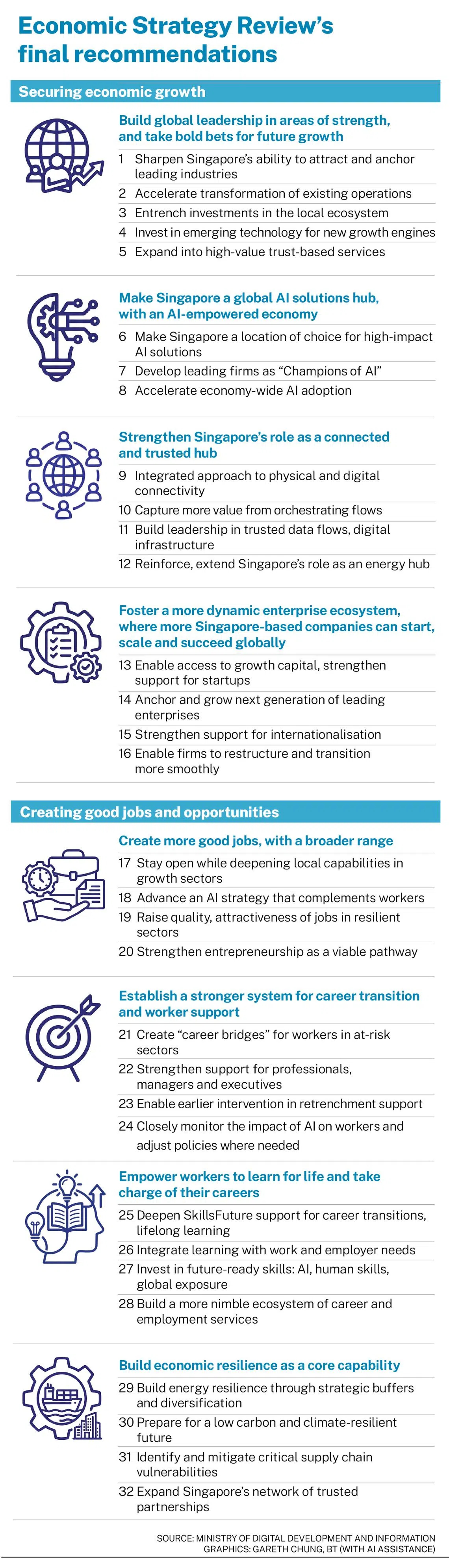
In its final report, the ESR reiterated the three “strategic imperatives” which will guide Singapore’s next phase of economic growth, and which inform the eight focus areas of the review.
First, the Republic must sharpen its value proposition, focusing on where it creates the most value and has “hard-to-replicate advantages”.
Second, its institutions, firms and workers must become more agile and adaptable.
Third, the country must “build resilience alongside efficiency”.
Formed in August 2025, the ESR committees held over 80 engagements with more than 7,700 people across various sectors.
32 recommendations
Of the eight focus areas in the report, the first is that Singapore should build global leadership in key industries while taking bold bets on emerging ones, even if every investment is not expected to succeed.
Second, it should position itself as a hub where artificial intelligence solutions are developed, tested and deployed, rather than competing to build frontier models or host data centres.
The third thrust is strengthening the Republic’s role as a connected and trusted global hub.
This includes its role as an energy hub. Said the report: “In the near to medium term, Singapore should continue to anchor and expand the trading mandates and operations of major oil and LNG (liquefied natural gas) players in Singapore.”
There may be scope to expand capabilities in areas such as LNG bunkering, ship-to-ship reload operations and supporting storage infrastructure, it added.
Singapore could also explore developing a futures market to support hedging of energy products.
The fourth thrust is to foster a more dynamic enterprise ecosystem that helps firms not just grow, but also restructure or transition when needed.
As part of this, the ESR called for foreign worker policies to be revised to better account for startups’ “unique circumstances”.
It proposed a review of the taxation framework for employee share option plans and other employee share ownership schemes, to help startups attract top-tier talent.
[[nid:735160]]
On jobs, the ESR called for creating a broader range of good jobs, alongside stronger support for workers facing career setbacks and disruption.
One specific proposal in the final report is to expand the SkillsFuture Jobseeker Support Scheme to cover more professionals, managers and executives.
The report noted that the scheme, for involuntarily unemployed workers, is currently capped at workers earning up to $5,000 a month.
Separately, elaborating on the earlier announced idea of “career bridges”, the ESR recommended identifying sectors with strong labour demand – such as the care economy – and investing in “transition pathways” into them.
For at-risk workers, data can be used to design more personalised job-matching and placement support.
“By analysing role adjacencies, labour demand, job transition patterns and wage prospects – and matching these with workers’ skills and competencies – more personalised transition pathways can be developed,” said the report.
“This can be complemented by targeted training to close skills gaps, and partnerships with industry to identify potential employers.”
The eighth and final thrust is to build economic resilience as a core national capability.
This includes improving energy security, taking a pragmatic approach to decarbonisation, and working with key industries to identify and mitigate supply chain vulnerabilities.
[[nid:735642]]
This article was first published in The Business Times. Permission required for reproduction.



