

Where to find HDB executive maisonettes under $900k in 2026

Here's where to find HDB executive maisonettes under $900,000.
PHOTO: Stackedhomes

Prior to the Executive Condominium (EC) scheme, Singapore had Executive Flats. Among these, the most famous are probably the Executive Maisonettes (EMs).
Introduced in 1983, these double-storey flats were a massive 1,400 to 1,600 sq ft; and they indicated a major advancement in housing policy.
The creation of these duplex units marked the point when HDB moved from the urgent, bare-bones housing of the post-Colonial era, to offering quality housing across different economic backgrounds.
The EM scheme only lasted little over a decade though, ending in 1995. At that point, there was also some consideration of “subvention creep” — the tendency of public welfare budgets to balloon if unchecked.
In the end, a compromise was made to tilt “sandwich” or aspirational housing toward the free market, in the form of the EC, which replaced the EM.
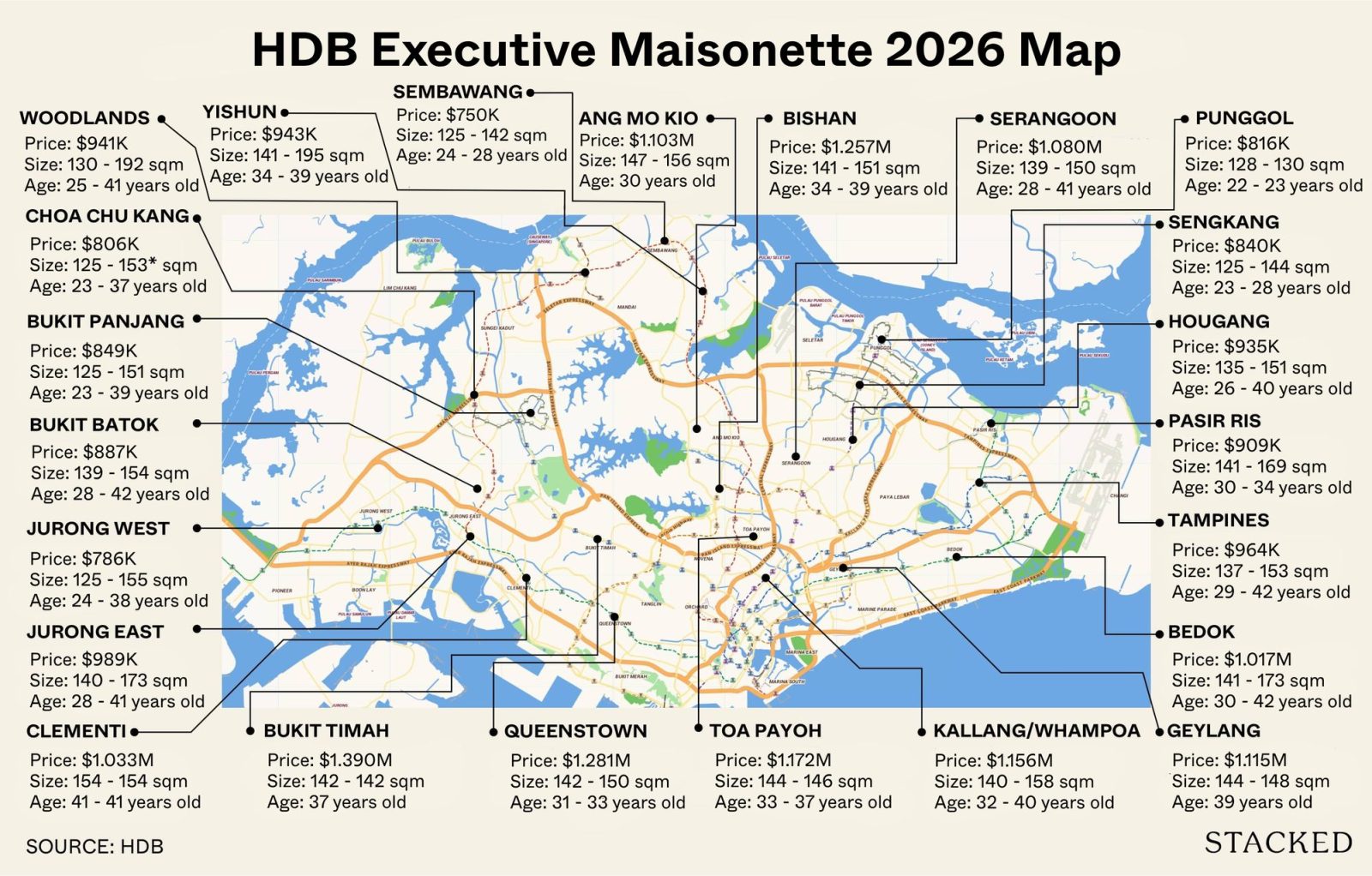
Today though, the remaining EMs are a particularly scarce and desirable form of HDB housing. While many are getting on in years, most are million-dollar assets; and they’re snapped up fast on the rare occasions they appear on the resale market.
*The following is based on recorded EM transactions from January 2025 to August 2026
| HDB towns | Size range (sqm) | Current age range | Average resale price | Number of transactions done |
| Ang Mo Kio | 147 – 156 | 30 | $1,103,250 | 8 |
| Bedok | 141 – 173 | 30 – 42 | $1,017,164 | 46 |
| Bishan | 141 – 151 | 34 – 39 | $1,257,378 | 5 |
| Bukit Batok | 139 – 154 | 28 – 42 | $887,233 | 52 |
| Bukit Panjang | 125 – 151 | 23 – 39 | $848,545 | 82 |
| Bukit Timah | 142 – 142 | 37 | $1,390,000 | 1 |
| Choa Chu Kang | 125 – 153* | 23 – 37 | $806,204 | 105 |
| Clementi | 154 – 154 | 41 – 41 | $1,033,000 | 1 |
| Geylang | 144 – 148 | 39 | $1,115,200 | 5 |
| Hougang | 135 – 151 | 26 – 40 | $935,004 | 47 |
| Jurong East | 140 – 173 | 28 – 41 | $989,249 | 38 |
| Jurong West | 125 – 155 | 24 – 38 | $785,601 | 152 |
| Kallang/Whampoa | 140 – 158 | 32 – 40 | $1,155,689 | 10 |
| Pasir Ris | 141 – 169 | 30 – 34 | $909,011 | 200 |
| Punggol | 128 – 130 | 22 – 23 | $815,612 | 43 |
| Queenstown | 142 – 150 | 31 – 33 | $1,281,417 | 6 |
| Sembawang | 125 – 142 | 24 – 28 | $749,719 | 108 |
| Sengkang | 125 – 144 | 23 – 28 | $840,014 | 141 |
| Serangoon | 139 – 150 | 28 – 41 | $1,080,410 | 26 |
| Tampines | 137 – 153 | 29 – 42 | $963,714 | 113 |
| Toa Payoh | 144 – 146 | 33 – 37 | $1,172,000 | 4 |
| Woodlands | 130 – 192 | 25 – 41 | $940,938 | 207 |
| Yishun | 141 – 195 | 34 – 39 | $942,955 | 48 |
*While it’s not visible here, the largest EMs are actually in Choa Chu Kang. Blocks 639 to 641 Choa Chu Kang Street 64 contain a handful of 215 sqm (around 2,314 sq ft) premium maisonettes.
They can be considered unique designs though, as only around eight such units reportedly exist in the cluster. Part of the high square footage is due to the inclusion of terrace-like spaces. None of these transacted in the past year, hence the table shows a maximum of only 157 sqm.
For those on the hunt for EMs, here are a few things to note:
Overall, ten of the 22 towns now have average prices above $1 million. We can say that Tampines is effectively at that level too, with an average of $999,611.
As of August 2026, the average quantum of an EM across the entire dataset is $978,000.
The most affordable EMs are found mainly in the north and west. HDB towns in these general areas still have EMs that fall below the $1 million mark, at around $800,000 to $900,000. The most affordable EMs seem to be found in Jurong West, Choa Chu Kang, Bukit Batok, Jurong East, Woodlands and Bukit Panjang.
The following towns still see EMs at below $900,000:
The majority of EMs sit within the second price band of pricing, around $900,000 to $1.1 million. These locations include Yishun, Pasir Ris, Tampines, Hougang, Bedok, Toa Payoh, Clementi and Serangoon.
Unsurprisingly, the most expensive EMs are in the more central and highly mature areas. At Ang Mo Kio, Bishan, Bukit Timah and Queenstown, you should expect even the cheaper options to still be above $1.1 million.
Thart said, the averages for Ang Mo Kio and Queenstown are not too representative, as we’ve only seen two and three transactions respectively.
Tampines and Hougang account for over a quarter (28 per cent) of all the transactions in the data. The largest transaction volumes came from:
We should note, however, that Tampines is an exceptionally large town — so it’s statistically likely to have the most transactions.
Nonetheless, we can see that central area EMs are not just expensive; they’re far scarcer on the market. Most EM transactions take place in the larger fringe areas, and you may have better luck looking there.
That said, there are a few other micro-location details to note:
Be aware that prices you see above are town averages only, and that the most convenient parts of a given town can diverge significantly.
Because EMs were constructed within a relatively narrow window, we see less in the way of price differences by age.
The earliest EMs appeared around 1983, with EMs rolled out more widely through the mid-to-late 1980s. HDB subsequently phased out the format during the 1990s, and the final EM blocks completed around 1998 to 2000.
This means the EMs in the dataset span almost the entire production cycle. In 2026, even the youngest are already approaching 30 years old, while the oldest have only around 57 years remaining on their leases.
However, location matters much more than age. For example:
This is not to say lease decay isn’t a factor. Rather, our point is that there are no genuinely “young EMs” against which the older ones can be compared. Location, scarcity and demand matter more than the 10-to-15-year age gaps.
If you want a relatively younger EM, you can look in places such as Sengkang, Bukit Panjang or Woodlands. One of the youngest EM clusters is at Block 310 Canberra Road in Sembawang. These EMs have a lease that commenced in 1998. Even so, the lower cost is more due to the location than the remaining lease.
The standard EM layout places all three bedrooms on the upper floor, together with the master bathroom and common bathroom. The lower floor usually holds the living and dining areas, kitchen, balcony, utility or study, and a common toilet. This is an old layout philosophy that separates communal from private spaces.
This is problematic with older residents however, as it means getting to and from the bedroom requires the use of the stairs. Some EM variants have a study or utility room downstairs that owners convert into a small bedroom. In some cases, you may find an EM where the previous owners have already renovated it this way. But you should check that it’s not small or poorly ventilated, which would be unpleasant for long-term use. Also, note that the downstairs toilet may not contain a shower.
This is even more likely to be the dominant role of the EM, as we move forward. Buyers today are paying close to, or above, $1 million for these flats that are already between 23 and 42 years old. Over a long holding period, the remaining lease will continue to shorten, eventually affecting financing, CPF usage, and the size of the prospective buyer pool.
We would also note that, as of August 2025, the Government confirmed it had no plans for further Sers projects. The first Vers exercises are expected only in the 2030s, when selected flats approach around 70 years old. The scheme is expected to be less generous than Sers, which should be a concern for owners and buyers of older flats (this by default includes EMs).
As such, buyers of EMs today shouldn’t depend on the sale proceeds of the property to fund a second move, or to significantly boost a retirement fund. Bear in mind the layout issues as well: if the stairs eventually become unmanageable, you could be forced to sell when the flat is older, and harder for prospective buyers to finance.
[[nid:742667]]
This article was first published in Stackedhomes.