

Private home price growth eases while HDB resale prices extend decline in Q2 2026: Flash data

Private home price eases while HDB resale prices decline in the second quarter of 2026.
PHOTO: AsiaOne file

Singapore's housing market continued to cool at a measured pace in the second quarter of 2026.
Private home prices still edged higher, although growth slowed to its weakest pace in seven quarters, while HDB resale prices declined for a second consecutive quarter.
The latest URA and HDB flash estimates suggest the market is shifting towards a more balanced phase, with buyers remaining active but increasingly price-conscious amid a wider range of housing options.
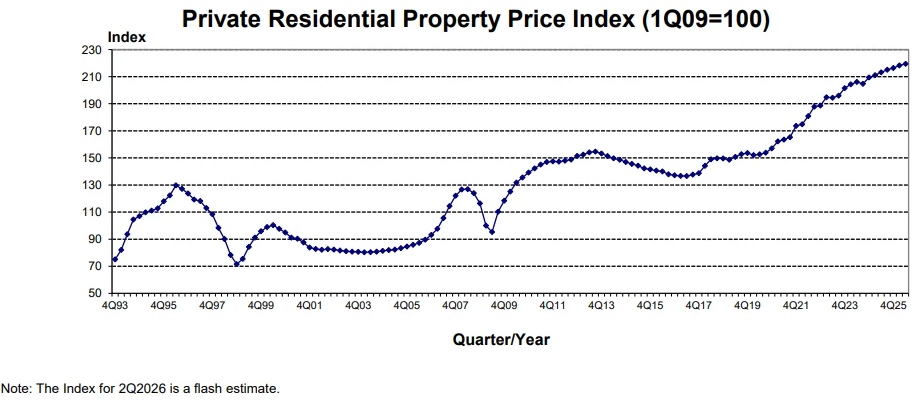
Private residential property prices rose by 0.5 per cent in the second quarter of 2026, according to the Urban Redevelopment Authority's (URA) flash estimates released on July 1.
While prices continued to climb, the pace moderated from the 0.9 per cent increase recorded in the previous quarter, reinforcing signs that the market is settling into a steadier growth trajectory after several years of rapid appreciation.
The moderation was largely driven by the non-landed segment, where prices slipped 0.1 per cent quarter-on-quarter after increasing 1.3 per cent in the first three months of the year.
The softer performance, however, masks notable differences across Singapore's three market regions.
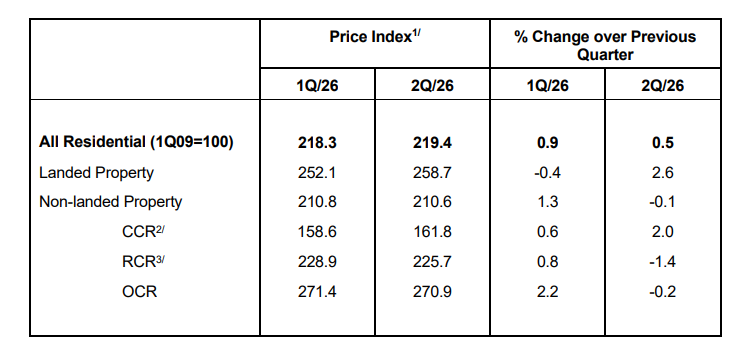
The Rest of Central Region (RCR) recorded the largest decline among non-landed homes, with prices falling 1.4 per cent after rising 0.8 per cent in the previous quarter.
One factor behind the decline was the launch of Hudson Place Residences in Media Circle.
Entering the market at a median price of $2,465 psf, around 6.5 per cent below the recent six-month RCR median, the project demonstrated that buyers remain highly responsive to competitively priced developments, particularly in emerging employment hubs such as one-north.
The Outside Central Region (OCR) also experienced a slight pullback, with prices easing 0.2 per cent compared to the 2.2 per cent increase in the previous quarter.
The launch of Tengah Garden Residences likely contributed to this moderation.
As the first private condominium in Tengah, the project attracted strong demand by entering the market at relatively attractive price levels compared with recent suburban launches.
What stood out during the quarter was the widening price dispersion within the OCR itself. While Tengah Garden Residences achieved strong sales at around $2,120 psf, Vela Bay attracted buyers at close to $2,900 psf, highlighting that suburban developments are no longer moving within a single pricing band.
Instead, launch prices are becoming increasingly differentiated based on project attributes.
The softer price movement in Q2 2026, therefore, reflects the composition of sales rather than weakening demand. Mr Luqman Hakim, Chief Data & Analytics Officer at 99.co, notes that "the slight pullback in RCR and OCR non-landed prices also points to greater buyer selectivity outside the prime market".
Nearly 60 per cent of all private home transactions during the quarter took place in the OCR — the highest proportion since 2015.
At the same time, transactions in the premium Core Central Region (CCR) fell to just around 12 per cent of total sales.
With more buyers purchasing lower-priced suburban homes, the overall price index naturally experienced slower growth.
Supporting this trend, more than 1,000 new private homes changed hands below $2 million, while the number of units sold below $2,000 psf increased sixfold compared to the previous quarter.
In contrast, the Core Central Region (CCR) remained the strongest-performing segment. Prices of non-landed homes in the CCR climbed two per cent, accelerating from 0.6 per cent in the previous quarter despite the absence of new project launches.
Instead, demand centred on existing developments such as River Modern and The Robertson Opus, where buyers continued purchasing remaining units at higher prices.
The performance reflects sustained demand from Singapore citizens and permanent residents upgrading into prime homes, alongside buyers recognising value as the pricing gap between CCR developments and those in the city fringe has narrowed over the past year.
This suggests that while affordability remains an important consideration across the broader market, well-located prime developments continue to attract buyers prepared to pay for quality and scarcity.

Unlike the non-landed segment, landed properties posted a much stronger quarter.
Prices rose 2.6 per cent, reversing the 0.4 per cent decline recorded previously and pushing the landed property price index to a new record high.
Market observers expect landed housing demand to remain resilient throughout the rest of the year, particularly for homes transacting between $5 million and $10 million, supported by the limited supply of landed housing in Singapore.
Although price growth moderated, transaction activity remained stable. URA's flash estimates indicate approximately 5,420 private home sales during the quarter, virtually unchanged from the 5,413 transactions recorded in the first quarter and around 4.5 per cent higher than the same period last year.
The stable sales volume suggests buyers have not stepped away from the market. Instead, purchasing decisions appear to be becoming more selective, with greater attention paid to pricing, location and long-term value.
A relatively small pipeline of launches, changes to executive condominium policies and the school holidays also influenced market activity during the quarter, although Singapore's resilient economy and low unemployment continued supporting housing demand.

Meanwhile, the HDB resale market extended its correction in the second quarter.
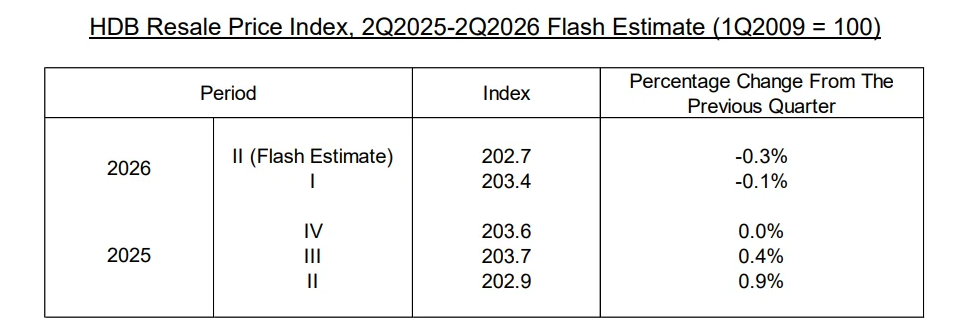
Flash estimates released by HDB show the Resale Price Index fell 0.3 per cent, following the 0.1 per cent decline recorded in the previous quarter.
This marks the first time in nearly seven years that HDB resale prices have declined across two consecutive quarters.
According to Mr Luqman, "the market is moving into a more balanced phase after years of strong growth".
The softer performance in Q2 2026 represents a sharp reversal from the first half of both 2024 and 2025, when resale prices continued posting significant gains.
"The moderation is likely supply-led, with more MOP flats entering the market and upcoming BTO supply giving buyers more options", Mr Luqman explains.
"This should help temper price expectations, although well-located flats with strong attributes are still likely to attract firm demand."
HDB recorded 6,268 resale transactions during the quarter, representing a 10.2 per cent decline from the previous quarter. Yet the high-value segment continues to defy the broader market trend.
Around 490 million-dollar HDB flats changed hands during the quarter, accounting for 7.8 per cent of all resale transactions, which is the highest proportion on record.
These million-dollar flat transactions in Q2 2026 are backed up by newly MOP-ed projects such as Bedok South Horizon, which recently made news for breaking the resale price record in town.
[[nid:737356]]
Interestingly, while overall transaction numbers reached a new high, the average price of these million-dollar flats edged down slightly to around $1.147 million.
An increasing share of these transactions also took place in non-mature estates, suggesting some buyers are shifting towards newer flats outside traditional prime locations as affordability pressures continue reshaping buying patterns.
Private home prices continue to rise in Q2 2026, but buyers are increasingly gravitating towards developments that offer stronger value, particularly outside the prime regions.
At the same time, the HDB resale market is benefiting from additional supply through new BTO launches and more flats reaching their MOP, helping to moderate the rapid price growth seen in recent years.
Looking ahead, upcoming launches in both the private and public housing markets will continue testing buyer appetite.
The October BTO exercise, which will introduce close to 8,000 new flats, alongside a growing pipeline of private residential projects, should provide buyers with more options in the second half of 2026.
[[nid:738747]]