

A look inside a rare multi-generation Bishan flat selling for $1.59m

A multi-generation flat in Bishan that's listed for $1.59 million
PHOTO: 99.co

A rare Multi-Generation (MG) HDB flat at 137 Bishan Street 12 has been listed for $1,588,888, offering buyers something that is not commonly found in Singapore's public housing market: a large, single-level home with a dual-key layout built into its original design.
Located within Bishan Green, the mid-floor unit spans 1,776 sqft, which works out to an asking price of about $895 psf. It currently comprises a three-bedroom main home and a separate one-bedroom space, with each section having its own living facilities.
According to listing agents Jason Lee and Christine Tan, the home could be particularly suitable for multi-generational families who want to live under one roof while still maintaining a sense of privacy and independence.
Multi-Generation flats were introduced by HDB in the 1980s to support families who wanted to live with their parents while still having clearly defined living areas.
Only a small number were built in Bishan, Yishun and Tampines before the flat type was eventually discontinued.
Today, just 495 MG flats are believed to remain across Singapore, with only 93 located in Bishan. "This is the type of unit that majority of buyers and even agents have never seen before," Jason added.
"They rarely come onto the market because owners tend to hold on to them."
HDB later revisited the idea of multi-generational living when 3Gen flats were introduced in 2013. Although both housing types aim to accommodate larger families, their layouts and eligibility requirements are different.
A modern 3Gen flat generally functions as one complete home. It comes with an additional bedroom and attached bathroom for the older generation, but the household still shares the main living, dining and kitchen spaces.
In comparison, an MG flat was designed with a more clearly separated studio area. The Bishan unit has three bathrooms, a full kitchen and a kitchenette, allowing the smaller section to operate more independently from the main home.
This offers what is essentially a natural dual-key arrangement, rather than one created later through renovation.
For families caring for elderly parents, this setup can offer a practical balance. Different generations can remain close enough to support one another while still having their own spaces for daily routines, rest and personal time.
Buyers searching for a home of this size may also consider executive maisonettes, executive apartments, jumbo flats or newer 3Gen units. However, each option works differently.
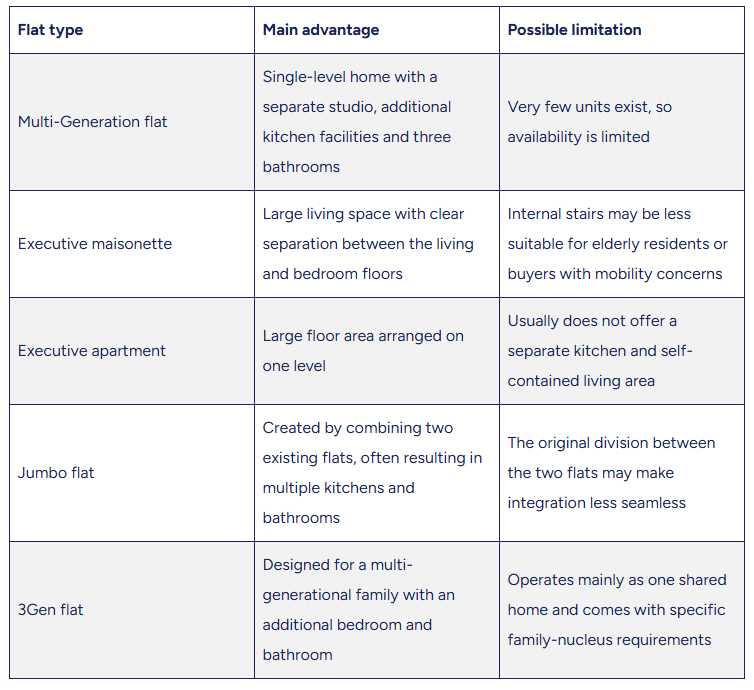
Executive maisonettes remain popular among buyers who appreciate their two-storey layouts.
However, the stairs may become less practical for older residents. This can also be a concern for families leaving landed homes precisely because they no longer want to manage multiple floors.
Executive apartments solve the problem of stairs because their entire floor area is placed on one level. Nevertheless, they usually lack the separate kitchen and living facilities that would allow two generations to maintain greater privacy.
Meanwhile, jumbo flats can offer more than one kitchen or bathroom because they were created by joining two units.
However, the original flats were designed as separate homes, which means parts of the layout may remain divided even after they are combined.

The Bishan MG unit provides greater flexibility in this respect. The studio can remain separate when privacy is needed. Alternatively, it can be opened up and reintegrated into the main home if the family prefers one much larger living space.
This flexibility is one of the key reasons Christine believes the unit's rarity is supported by practical value, rather than rarity alone.
"A property can be rare and useful, but it can also be rare without offering much flexibility," she explained. "Here, the size, layout, location and different ways the space can be used all work together."
Dual-key layouts are more commonly associated with private condominiums, where a larger main residence is paired with a smaller studio or one-bedroom unit connected through a shared entrance. Within HDB flats, however, this arrangement is far less common.

While some homeowners create a similar setup by adding partitions or reworking the internal layout, this MG flat was designed with two distinct living areas from the beginning.
Its original floor plan featured a three-bedroom main home alongside a separate studio with its own kitchenette and bathroom, allowing both sections to support different day-to-day routines.

The current owners later adjusted the layout because they initially planned to rent out the studio. By reallocating part of the main home, they were able to turn it into a more comfortable one-bedroom unit instead of keeping it as a compact studio.
Today, the main section spans approximately 1,200+ sqft and includes three bedrooms and two bathrooms. The master bedroom has been enlarged to include a walk-in wardrobe, while the kitchen is fitted with a gas cooker.

Meanwhile, the separate one-bedroom section measures about 500 sqft. It comes with its own bedroom, living area, sizeable kitchen with storage, and a bathroom with separate shower and water closet areas.
As a result, the smaller section feels more like a self-contained home than simply an extra bedroom.

Another unusual feature is found at the entrance. In the original floor plan, an access balcony sat outside the two sections of the flat, which meant that some MG units in the block had two separate front doors opening directly from the common corridor.
The previous owners purchased this access balcony and incorporated it into the home.
"As a result, the unit now has one outer entrance that opens into a private foyer, followed by two internal doors leading to the main home and the one-bedroom section," Christine explained.

This arrangement allows the two spaces to function independently when the home is used in a dual-key format. At the same time, the enclosed entrance makes it easier for future owners to combine both sections and use the entire unit as one large residence.
More importantly, the layout can be adapted as the household changes over time. An elderly parent could occupy the smaller unit first, for example.
Later, the same space could be converted into a home office, a teenager's living area, accommodation for a helper or an extension of the main living space.

For larger households, the unit may also be reconfigured to provide more bedrooms.
Based on a proposed renovation concept, the 1,776 sqft floor plate could potentially accommodate as many as six bedrooms. One of the layout's key strengths is that the bedrooms would be positioned along the outer edges of the home, allowing each room to have access to a window.
"It is almost impossible to find a home in Singapore where six bedrooms can all have windows," Jason said.

Of course, not every household will need that many rooms. Some buyers may prefer to retain the current three-bedroom main home and separate one-bedroom section, while others may opt for four larger bedrooms and a more generous shared living area.
Even so, the six-bedroom concept demonstrates how adaptable the unit's rectangular layout can be.

The home is also said to enjoy good natural light and ventilation, along with an unblocked outlook and views of greenery.
As the existing interiors have been well maintained, buyers may choose to move in with only minor updates or carry out a more extensive renovation to suit their needs.

Renovation ideas can also be explored during viewings, giving interested families a clearer sense of how the space could be adapted to their household size and lifestyle.
The unit's rarity is only one part of its appeal. Its location in Bishan is likely to be just as important to prospective buyers.
Bishan is well established, centrally located and connected to several parts of Singapore by both the North-South and Circle MRT lines.
The flat is around 1.1km, or an estimated 13-minute walk, from Bishan MRT station and Junction 8.
Alternatively, residents can take a short bus ride of around three stops. The route from the block to the nearby bus stop is also fully sheltered, making everyday travel more comfortable during wet or hot weather.
For daily needs, Chung Ling Wet Market, minimarts and neighbourhood eateries are located approximately 400m away, or around a five-minute walk from the block.
Several primary schools are also located within 1km, including Kuo Chuan Presbyterian Primary School, First Toa Payoh Primary School, Pei Chun Public School and Kheng Cheng School. Raffles Institution and Raffles Girls School (Secondary) is also within the surrounding area.
These amenities may be particularly valuable to a multi-generational household. Elderly family members can reach nearby shops without travelling far, while parents and children benefit from the area's schools, transport links and established facilities.
The Bishan location also helps set these MG flats apart from similar units in Yishun and Tampines. While all three towns offer established facilities, Bishan's more central position may widen its appeal beyond buyers specifically looking for an MG flat. It may also attract households that already want to live in Bishan and see the rare layout as an added advantage.
Bishan has frequently appeared in the news for high-value HDB resale transactions, particularly involving larger or less common flat types.
In November 2025, an executive maisonette at nearby Block 135 was sold for $1.6 million. While an executive maisonette and an MG flat should not be treated as direct comparables, the transaction provides some indication of the demand for spacious homes within the neighbourhood.
Interest in MG flats is also not limited to Bishan. In March 2024, a Multi-Generation unit in Yishun changed hands for $1.2 million, suggesting that buyers are willing to pay a premium for the space, privacy and flexibility offered by this rare flat type.
According to the agents' review of available records, the previous MG sale in the same area took place slightly more than a year ago, while the transaction before that was recorded in 2021.
In other words, only two such units appear to have changed hands in the block over roughly five years.
As the block was completed in 1987, the flat has approximately 60 years remaining on its lease.
This is likely to be an important consideration, especially for younger buyers purchasing with a longer investment horizon.
The remaining lease may also affect financing and CPF usage, depending on the buyers' ages and whether the flat can cover the youngest buyer for the period required under prevailing rules.
However, Christine believes the home may be a more natural fit for buyers in their late-40s to 60s than for a young couple purchasing their first property.
Some may be caring for elderly parents while still supporting older children who live at home. For these households, the immediate priority may be finding one property that can accommodate everyone comfortably.
The remaining lease could therefore be sufficient for the household's expected period of occupation.
Rather than focusing only on whether the lease will last another generation, these buyers may place more weight on the quality of life the home can provide today: space for elderly parents, room for growing children and separate areas that make daily life more comfortable for everyone.

The home is likely to appeal to a specific group of buyers rather than the wider resale market.
Its clearest audience is a multi-generational household that wants to stay under one roof without having to share every part of the home.
Elderly parents could occupy the separate one-bedroom section, for example, while their adult children and grandchildren live in the main three-bedroom unit.
It may also suit the "sandwich generation", who are supporting ageing parents while still caring for school-going or young adult children.
Keeping everyone close can make caregiving and everyday routines easier, while the two living areas may reduce some of the strain that can arise when several generations share the same kitchen, bathrooms and common spaces.
Another possible buyer group is households moving from private or landed housing. These families may be accustomed to more generous living areas but now want a single-level home that is easier to maintain.
At 1,776 sq ft, the unit offers substantially more space than a typical HDB flat, which could make the transition feel less restrictive.
The setup may also appeal to owners who want the option of generating rental income while continuing to live in the main section of the flat.
Compared with renting out a bedroom within the family home, the separate facilities could provide clearer boundaries and greater comfort for both the owners and tenants.
Large HDB flats are already limited in Singapore, while genuine Multi-Generation units form an even smaller part of the housing stock.
With less than 500 such flats across the country and only 93 in Bishan, the number that becomes available for sale in any given year is extremely small.
Many remain with their original families or are passed between generations, which further limits the resale supply. "It is difficult to say when another one of this type will appear on the market," Jason said.
"When you also consider the flexibility and location, it may be some time before buyers see a similar opportunity again."
For families who specifically need a large, single-level home with two semi-independent living areas, the main challenge may not simply be finding a less expensive option. It may be finding another HDB flat that can meet the same combination of needs at all.
[[nid:740036]]