

The cost of being a global city: How Singapore's housing and office costs are changing the talent race

Here's a look at how Singapore's housing and office costs are changing the talent race.
PHOTO: AsiaOne/Danial Zahrin

For decades, major global cities like London, New York, Singapore, and Tokyo have dominated international markets as command hubs for capital and decision making.
But as technology advances, it has enabled companies to distribute functions across different cities.
A research report by Savills, titled the Global Talent Index, suggests that a new corporate geography is emerging that has flipped the traditional relationship between workers and their jobs.
Singapore was the leading city in the Asia Pacific region, with London and New York taking the top two spots on the global list, respectively.
The index was based on five key pillars: Talent pool, liveability, competitive landscape, economic resilience, and cost efficiency.
Other metrics included salary levels and real estate expenses.
Among the global rankings, Beijing was in seventh place, Shanghai in eighth, Hong Kong in 13th, Kuala Lumpur in 15th, and Sydney in 20th position.
The report highlighted that the past decade has also seen slowing cross-border migration of skilled workers, while frequent macro-economic volatility has made finding and retaining talent much more complex.
It says that companies are no longer asking talent to relocate.
Instead, companies are setting up offices and moving into cities where they can find the skills and talent pools to match their strategy.
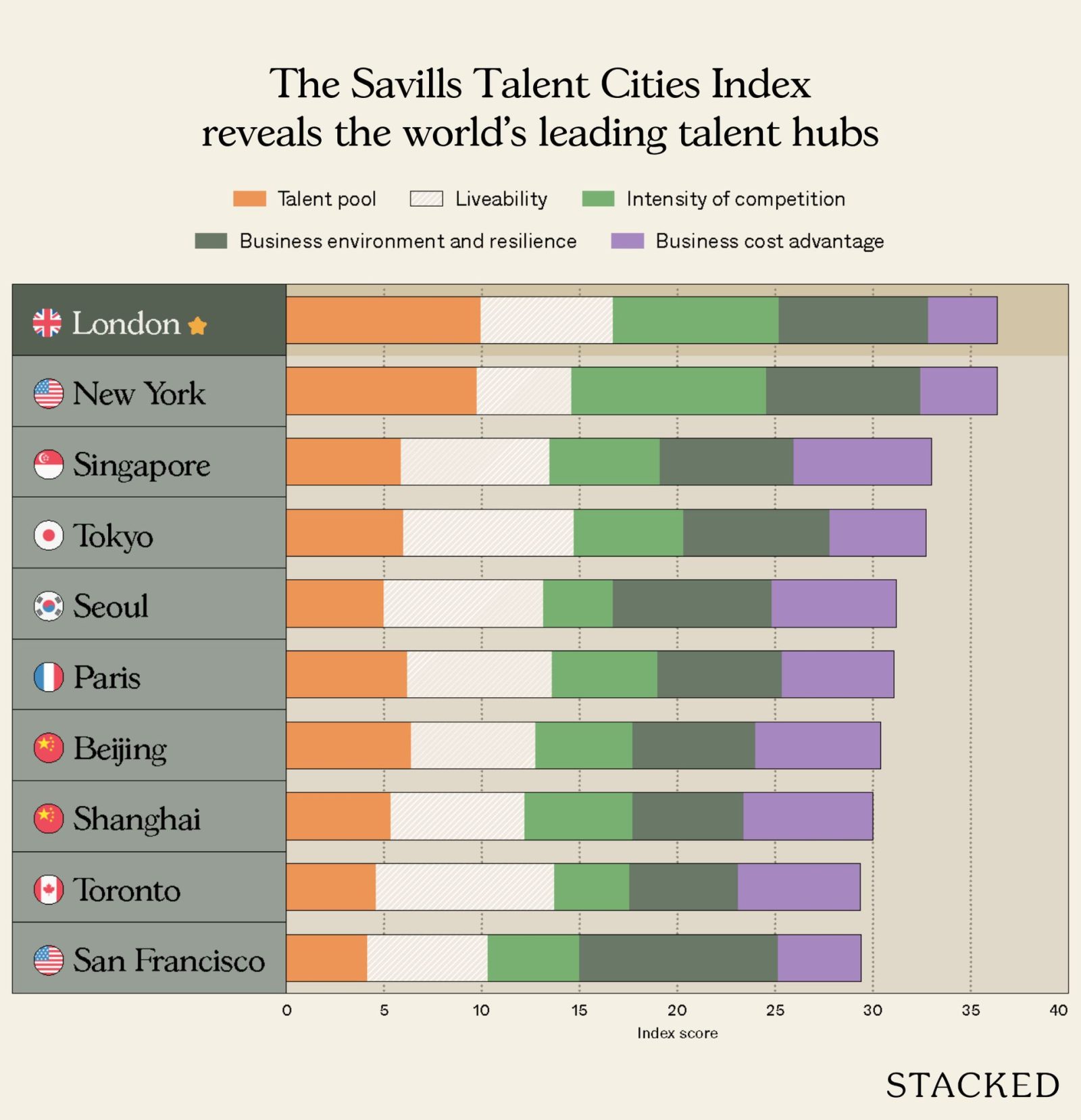
Savills identifies Singapore as an archetype city centred on attracting global business leaders.
Similar cities include New York, London, and Tokyo who play host to corporate headquarters and leading client engagement, and leadership.
These cities have the deepest talent pools and a dense network of corporate ecosystems and venture capital, they also feature some of the highest-quality office stock.
But they also suffer from steep challenges that influence the workforce.
The concentration of high-skilled talent often results in rising cost pressures in terms of living and housing, there is also an intense competition for the right talent.
Companies also face much higher operating costs and steep talent retention challenges.
Research cited by Savills indicates that almost two-thirds of organisations in cities like Singapore, New York, and London reported a reduction in talent availability in their headquarters location.
This rose to 73 per cent of companies in the technology sector.
This is pushing companies to expand into new markets to access skills.
“When everyone goes to the same place for talent, there is no competitive advantage left. Instead, we find saturated hiring markets, wage inflation already underway and talent with too many options,” says Michelle Needles, Global Head of Enterprise Solutions, global Occupier Services at Savills.
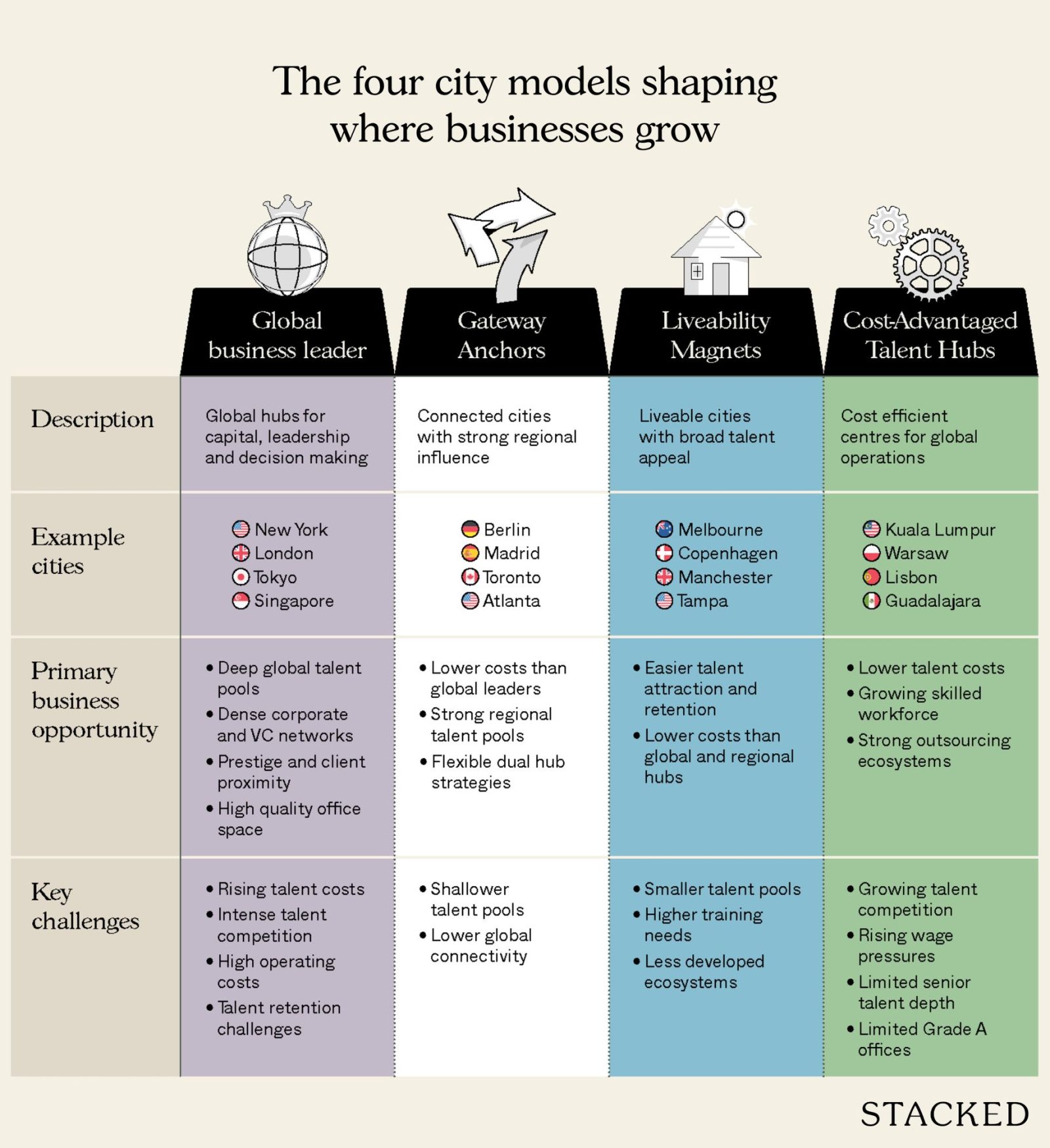
On the other hand, Kuala Lumpur has its edge as well, and Savills identifies it as one of several cost-advantaged talent hubs.
These are cost-efficient delivery centres that support other global operations. Examples include Warsaw, Lisbon, and Guadalajara in Mexico.
These cities have numerous business opportunities due to their talent cost advantage, a growing skilled workforce, as well as government incentives and outsourcing ecosystems.
Savills points out that growth, innovation, and operations are increasingly distributed across talent matched locations.
“Major global cities remain crucial for senior decision makers to connect with key clients and capital, but they’re now part of wider office networks that support growth, provide access to talent and improve cost efficiency,” says Sarah Brooks, Associate Director in Savills World Research.
However, their growth potential also results in challenges over time, such as wage inflation reducing cost arbitrage over time and constrained Grade A office availability.
Other city archetypes that Savills identified in their report were Liveability Magnets (Melbourne, Copenhagen, Manchester, Austin); Gateway Anchors (Berlin, Madrid, Toronto); Emerging Innovation Engines (Bengaluru, Hyderabad, Mumbai); and Sector Clusters (Boston, Zurich).
A surprising point raised in the report is that cities which excel in terms of liveability often rank lower in terms of talent depth and competitive intensity.
While it may appear to be a disadvantage, lower competition for talent supports stronger retention, and a higher quality of life can foster greater employee satisfaction, productivity, and long-term engagement.
Because talent availability in traditional headquarters locations is decreasing, and expanding into new markets provides access to skills and talent pools.
Kuala Lumpur offers cost-efficient delivery centres, a growing skilled workforce, government incentives, and outsourcing ecosystems.
They face rising living and housing costs, intense competition for talent, higher operating costs, and talent retention challenges.
Cities with high liveability often rank lower in talent depth and competitive intensity, which can support better talent retention and employee satisfaction.
[[nid:737424]]
This article was first published in Stackedhomes.