SEREMBAN - Barisan Nasional (BN) declared that it had reclaimed Negeri Sembilan after the Aug 1 state polls, with official results showing it took 25 out of the 36 seats, together with its ally Perikatan Nasional (PN).
This means that Prime Minister Anwar Ibrahim's Pakatan Harapan (PH) has lost the central state after two terms in power here, in a third consecutive setback at the state elections after huge losses in Johor in July and Sabah in November 2025.
According to official results, PH won 11 seats, down from the 17 in the previous 2023 state election, while PN won seven seats, up from the five it won in 2023.
"So far, Barisan Nasional has secured 18 seats, while Perikatan Nasional has won seven. With this result, the BN-PN alliance has obtained a two-thirds majority," BN president Ahmad Zahid Hamidi said at a press conference on the night of Aug 1.
He added: "We will hold further discussions on the election outcome and the next course of action. God willing, this co-operation will also extend to the state of Melaka."
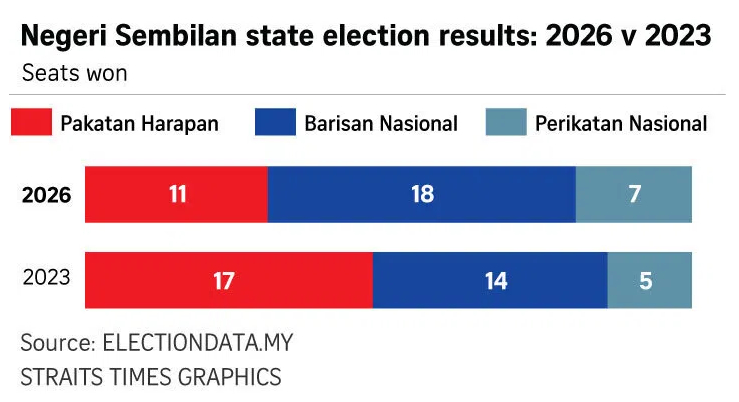
At the Negeri Sembilan election, BN had worked out an informal electoral pact with PN, after gaining the support of PN's Parti Islam SeMalaysia (PAS) in the Johor election. BN contested 25 seats in the Negeri Sembilan legislature, leaving the remaining 11 to its new partner.
PH and the UMNO-led BN are set to do battle again in the coming months in neighbouring Melaka, likely to be the last chance for Anwar's coalition to boost its morale before a general election due by early 2028.
Sarawak must also go to the ballot by early 2027 but the dominant Gabungan Parti Sarawak, an ally of PH in the federal government, is expected to retain the state.
BN's wins in Johor and Negeri Sembilan, if replicated in Melaka, will mean a huge momentum behind those who want the BN-PN Malay-Muslim alliance to co-operate at the 16th General Election and beyond.
Malays make up the majority in 123 of the 222 parliamentary wards, well in excess of the 112 needed for a simple majority to form the federal government.
In a statement on Aug 1, Anwar congratulated BN, PH's partner in the federal government, on its win.
He said: "Our gratitude to all the people of Negeri Sembilan for the faith placed in Pakatan Harapan and Aminuddin Harun as Menteri Besar for eight years. The federal government will continue to support and co-operate with the new Negeri Sembilan administration."
One of the notable defeats of the night was that of Transport Minister Anthony Loke, secretary-general of the Democratic Action Party (DAP) under PH. He failed to defend Chennah, a seat that he had held for the past three terms, losing narrowly to BN newcomer John Siow.
Speaking to reporters after conceding defeat in Chennah, Loke said he was considering stepping down as DAP's Negeri Sembilan chief.
"If I can't defend my seat, of course my consideration is to relinquish my state chairman position. But I will consult with other DAP leaders before I make the decision. As far as my role as secretary-general, I will discuss with the central executive committee on what's our way forward," he said.

Racial rhetoric, royal crisis
Another PH politician who lost was Negeri Sembilan caretaker Menteri Besar Aminuddin, who failed to win in UMNO stronghold Linggi. He moved there from his long-time stronghold of Sikamat, which PH lost as well, to PN.
At a post-election press conference, Aminuddin said he accepts the decision made by voters, has no regrets and would work to help PH in the Melaka state election.
PH election director Amirudin Shari attributed PH's losses to the use of racial rhetoric by its rivals in the campaign.
"The election featured a campaign marked by racial rhetoric which can cause unease among Malaysians."
During the campaign, there was the use of racial rhetoric, with PAS election director and Kedah Chief Minister Sanusi Md Nor's "Malays only have Tanah Melayu (Malaya), Chinese have China, Indians have India" comment becoming one of the hottest talking points.
The campaign also took place amid the state's royal succession dispute, which erupted when four chieftains, called the Undang, attempted in April to depose the incumbent ruler, later installing his cousin as the new ruler on June 5.
BN had used the dispute to criticise the PH-led state government, arguing that it failed to manage the situation effectively.
Despite this, ST has learnt that BN's Zahid had an audience late on Aug 1 with state ruler Muhriz Munawir to present BN's claim to form the next state administration.
At the press conference, Zahid said, referring to PN: "We will hold further discussions between the two coalition parties to finalise the formation of the new state government, subject to the consent of His Royal Highness the Yang di-Pertuan Besar and the four Undang."
Meanwhile, Jalaluddin Alias, who is the Negeri Sembilan UMNO chairman and said to be BN's Menteri Besar candidate, retained his seat in Pertang with a bigger majority.
Jalaluddin said at a press conference that BN has yet to name its Menteri Besar candidate. He said a decision would be made as soon as possible but declined to comment on who was being considered.
In a statement on Aug 1, PAS president Hadi Awang thanked Negeri Sembilan voters for their support, saying the result endorsed efforts to foster greater unity while upholding justice, social well-being and harmony in Malaysia's multiracial society.
Voter turnout a factor?
Mujibu Abd Muis, a political analyst at Universiti Teknologi MARA, said BN's victory should not automatically be interpreted as a rejection of the unity government under Anwar at the federal level.
"State elections have their own dynamics, where voters tend to prioritise state leadership, local governance and candidate credibility over national politics."
The result also indicated that organisational strength, credible candidates and local issues remained more influential than national narratives alone, he said.
Turnout can also be a factor, said Mujibu. Voter turnout was 72.64 per cent, up from 68.35 per cent in 2023.
"The key issue is not simply overall turnout, but which coalition succeeds in mobilising its supporters more effectively. In closely contested seats, even a small difference in turnout can alter the outcome," he said.
PH has traditionally relied more heavily on urban, younger and non-Malay voters, many of whom work or study outside their registered constituencies, he said. Their willingness to return home to vote could significantly influence PH's performance.
In contrast, BN generally benefits from a more geographically rooted support base in many rural and semi-urban constituencies, where the cost of voting is relatively lower.
However, turnout remained a challenge for both coalitions in converting support into actual votes, with PH's performance tending to be more sensitive to fluctuations in turnout, particularly in mixed and urban constituencies, he said.
[[nid:740135]]
This article was first published in The Straits Times. Permission required for reproduction.



