

Gift of life: These patients are thriving after undergoing organ transplant decades ago

Dr Leong Sai Fan received a life-saving kidney transplant from his wife, Quek Seow Chiang.
PHOTO: Dr Leong Sai Fan

 PUBLISHED ONJuly 25, 2026 11:30 PMBYCarol Ong
When Leong Kwai Sin learnt that she needed a kidney transplant in 1985, her first thought was: "Why me?"
She was only 28.
More than four decades after receiving a kidney from her brother, Kwai Sin, now 70, is one of the National University Centre for Organ Transplantation (NUCOT)'s longest-surviving patients.
"Every day since has been a gift," the housewife said.
Speaking to AsiaOne, Kwai Sin shared that she didn't jump at her brother's offer of organ donation although she felt there was "very little hope left" while waiting for a suitable donor.
"My first reaction was that it would be unfair of me to demand that he should donate one of his kidneys to me, and I felt very reluctant to accept his offer," she told us.
Kwai Sin's other siblings reassured her, saying that they would have all done the same for her and that their brother "actually felt happy" to be able to save her life.
She eventually agreed to the surgery, but she still had doubts and fears.
"There wasn't much of a history of successful kidney transplants from live donors in Singapore (at the time), and nobody could tell how long kidney transplant patients would survive even after successful transplantation," she explained.
Still, she was thankful.
"I felt grateful that I had been given another chance to live again," she said.
After recovering from surgery, Kwai Sin began looking forward to the future, this time with a different outlook to life.
"I was cautiously optimistic about resuming my life and relationships. I began to see myself start a new chapter of my life, with renewed hope and aspirations of building a new life and family," she told us.
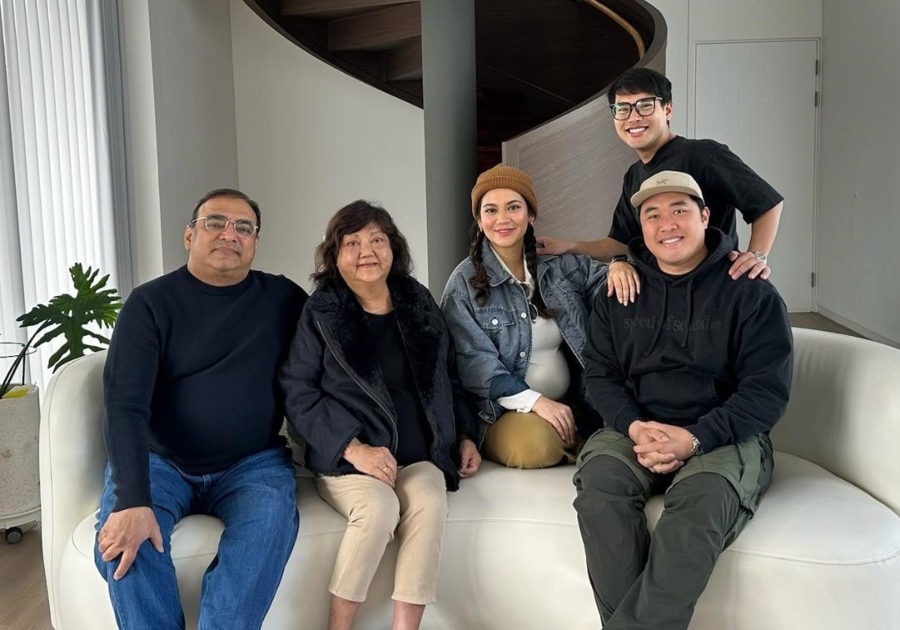
She went on to have two children with the support of her doctor and healthcare team.
"I am especially grateful to Professor Vathsala, who not only cared for me medically but supported me wholeheartedly when I hoped to start a family," she said.
The doctor had tailored Kwai Sin's post-transplant care to make sure she was healthy enough to conceive.
"I always felt safe under her guidance."
Having faced the uncertainty of waiting for an organ transplant herself, Kwai Sin now encourages others in similar situations not to lose hope.
"Be full of optimism and hope, good things happen at the most unexpected moments," she said, adding that today's donor-matching system is "much more developed and mature".
"The chances of finding matches have improved, and so have the chances of successful transplant operations even when the match isn't very high."
International statistics cited by NUCOT show that a deceased-donor kidney transplant typically lasts for eight to 12 years, while a living-donor kidney transplant lasts 15 to 20 years on average.
At NUCOT, average survivals for adult kidney transplants involving deceased donors and living donors are 15 and 31 years respectively — outcomes that surpass international benchmarks by two- to four-fold.
For Dr Leong Sai Fan, 70, learning that his kidneys were failing nearly 30 years ago brought on a different fear.
Then 41, he worried about how his wife would manage their young family while supporting him through dialysis, and what all this would mean for his career.
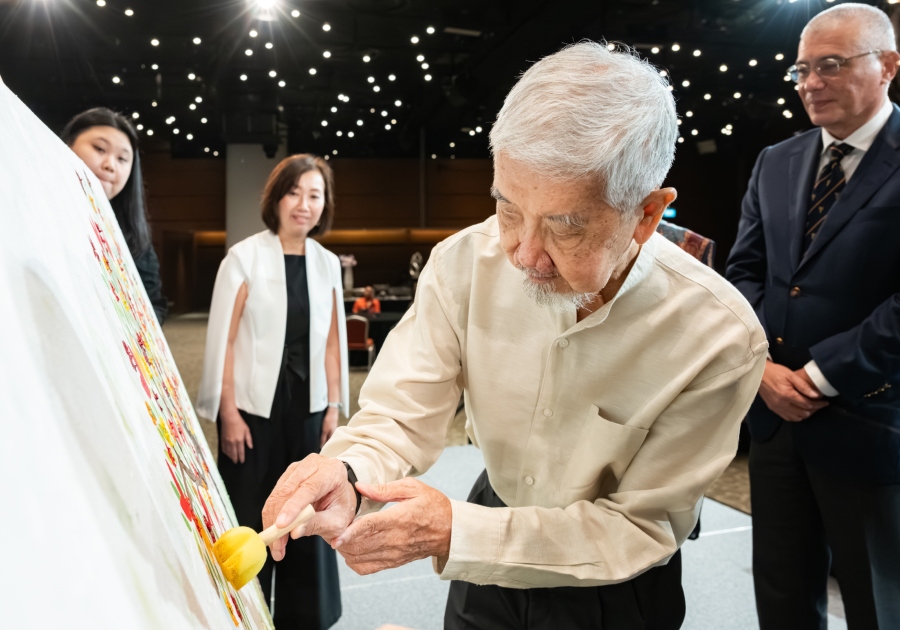
"There was a feeling of sadness that I could not provide for my family when my three young children and spouse needed me most during their growing years," he told AsiaOne.
He spent five months undergoing dialysis while waiting for a kidney transplant.
With deceased-donor kidneys in short supply, Dr Leong expected to be on the national transplant waiting list for at least five years. His siblings were not suitable donors, and his mother was above the recommended donor age at the time.
He resolved to "hope for the best" while waiting, and keep himself as healthy as he could, he said.
"I had to take an optimistic outlook while facing this reality. After all, at age 41 then, I still considered myself young and could lead a useful life after transplant when a kidney was available," he added.
Then came the news that his wife, Quek Seow Chiang, could be considered as a donor. She volunteered immediately.
As organ transplants between genetically unrelated individuals were not commonly permitted then, the hospital had to seek special approval from the Ministry of Health (MOH) for the procedure.
A few weeks later, Seow Chiang was found to be a suitable match and donated a kidney to him in 1997.
"I was extremely grateful that my wife stepped up instantly to offer hers. I thank her for this unconditional gift of life," Dr Leong said.
Nearly three decades later, the transplanted kidney is still functioning.
The successful organ transplant and his wife's sacrifice gave Dr Leong a new lease of life — advancing in his career, travelling with his wife, watching their children grow up, and becoming a grandfather of four.
He is now semi-retired and works as a quality management adviser to a pharmaceutical company.
Reflecting on his experience, Dr Leong said: "I once thought it was not possible for me to get back to a normal life when faced with end-stage kidney disease, but life has changed for the better after transplantation."
Both Kwai Sin and Dr Leong are patients of Professor A Vathsala, director of NUCOT at National University Hospital.
They were among the 35 long-term transplant survivors who were celebrated at NUCOT's Silver Jubilee event held in March.
While these two long-term survivors show what life can be like after successful organ transplants, Prof Vathsala said Singapore continues to face a shortage of organ donors.
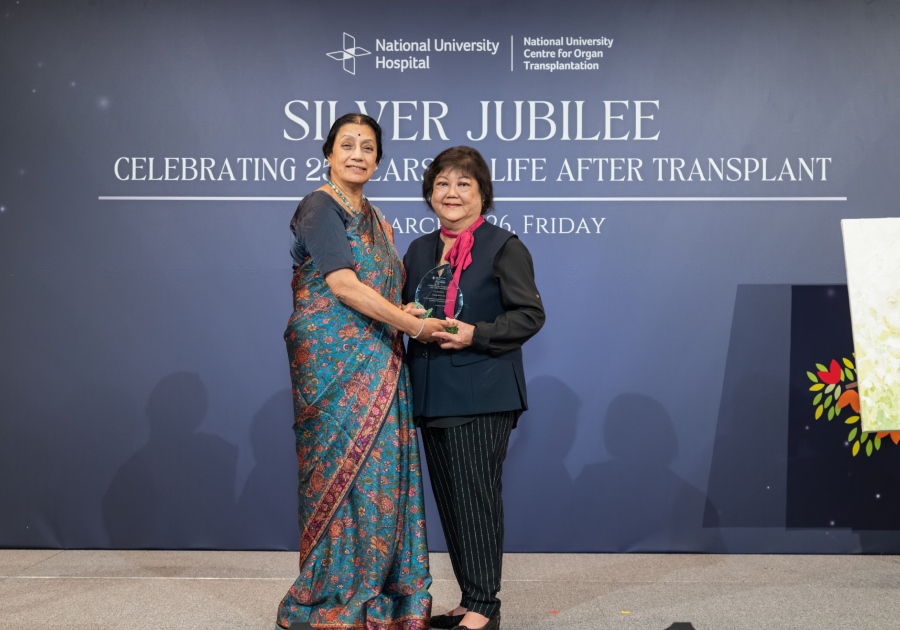
Referencing MOH's statistics, she said that 91 kidney transplants were performed for Singapore citizens and permanent residents in 2025, down from 103 in 2024.
That translates to about 22 to 24 kidney transplants per million people, as compared with an end-stage kidney failure rate of 401 per million.
"We are transplanting less than six per cent of the kidney failure population," she told AsiaOne.
As of December 2025, more than 400 kidney patients undergoing dialysis were waiting for a transplant, with an average waiting time of 8.6 years, she added.
The waiting list is also already restricted to patients considered most likely to benefit from a transplant. Some may also become medically unsuitable during the wait.
"If we had more donors, we could put more on the wait list," she said.
According to Prof Vathsala, living organ donors like Kwai Sin's brother and Dr Leong's wife currently account for approximately 55 to 60 per cent of kidney transplants performed in Singapore. More can be done to encourage donation rates.
"In surveys, many people are willing to give a kidney to their loved ones, but do not do so when the opportunity arises," Prof Vathsala said, adding that this could be due to a number of misconceptions.
Some of them include how live donors could develop organ failure themselves after the transplant, and becoming infertile among others.
These can all be managed and addressed, Prof Vathsala explained, emphasising that donors undergo extensive medical, and if appropriate, genetic screening before surgery, and undergo follow ups for life after organ donation at NUCOT.
"We don't have a crystal ball to check which medical condition anyone can develop in the future. However, with our thorough screening, most conditions can be picked up," she reassured.
[[nid:689010]]
No part of this article can be reproduced without permission from AsiaOne.