

28-year-old graduate learns hawker trade in secret, opens Hokkien mee stall to fulfil dream

Despite having a degree in engineering, Jing Herng wants to chase his dream and become a hawker.
PHOTO: AsiaOne/Melissa Teo

 PUBLISHED ONJuly 07, 2026 11:00 PMBYMelissa Teo
 While Tan Jing Herng spent his university days studying engineering, his heart has always been in the kitchen.
Upon graduation, instead of pursuing a career in his field, he chose to learn how to wield a wok.
Now, the 28-year-old is the proud owner of Herng Hao Chi Hokkien Mee at Toa Payoh Lorong 8, which opened on June 1.
When Jing Herng first learned how to cook the dish, he did so in secret at Hokkien mee hawker chain Shiok Hokkien Mee, he told AsiaOne in an interview on June 25.
Even his mother, who is also a hawker, didn't know he was working at a Hokkien mee stall.
"I didn't tell my parents, I just started work first. My mum wanted me to get an office job because she knew that being a hawker is very physically demanding, and the long hours make it very tiring," Jing Herng shared.
Speaking to her about his choice of work was a scary thought for him at first. But eventually, he mustered the courage to do so.
"She initially thought that me becoming a hawker was a waste," revealed Jing Herng. "Because I studied in university and spent four years learning engineering, but I didn't pursue that."
But after some time, she got used to the idea and became supportive of him and even helped him set up his own shop.
For Jing Herng, becoming a Hokkien mee hawker was a no-brainer.
"I've always loved Hokkien mee. I was quite fortunate to spend one and a half years learning the craft under Shiok Hokkien Mee. My time with them taught me the fundamentals," he shared.
"Not just cooking, but also the discipline, consistency and hard work that goes into running a hawker stall. As time went by, I realised I had a dream to build something of my own."
When Jing Herng graduated from the National University of Singapore (NUS) in 2023, he initially spent a few months "half-heartedly" hunting for jobs related to his engineering degree.
"But I realised that I wasn't very interested in that field of work, so I decided to take a leap of faith and do something totally unrelated," he said.
Pursuing a career in the food industry was a natural alternative as he had always enjoyed cooking.
When Jing Herng came across an Instagram post from Shiok Hokkien Mee saying they were looking for stall assistants, he seized the opportunity and joined the team in October 2024.
He wasn't completely new to this as he had previous part-time experience doing kitchen prep work. Still, he had never cooked Hokkien mee before and had to learn the craft while on the job.
He then left Shiok Hokkien Mee in May this year to open his own stall at the same hawker centre where his parents and uncle work at.
"I was keen on setting up my stall at Toa Payoh Lorong 8 because I could be closer to my family. This market is a part of my childhood. My grandfather used to sell duck rice here, and he passed the business down to my uncle," he shared, adding that his family lives nearby in Ang Mo Kio.
Before Jing Herng took over his current unit, it was previously occupied by Serangoon Garden Fried Prawn Noodle.
His parents, who own a yong tau foo shop, knew the stall's former owner, and Jing Herng had also spoken to the elderly man a few times.
The owner, who was looking to retire, even asked if he would be interested in taking over the unit, so Jing Herng jumped at the opportunity.
His best friend helped him come up with the name Herng Hao Chi Hokkien Mee, a cheeky play on Jing Herng's name and the Chinese saying for something that's "very nice to eat".
Jing Herng's parents, who have been hawkers for years, helped with sourcing cutlery and kitchen equipment.
He declined to share how much he pumped into the business and its running costs.
While his siblings were a little confused by his career path, it didn't stop them from showing him their support.
"My siblings thought it was an unconventional choice, but they are still supportive," he said, adding that they have no plans to become hawkers like him and are currently working in corporate jobs.
Meanwhile, two of Jing Herng's friends — a former junior college schoolmate and a former colleague from his previous F&B job — offered to work at the stall. Occasionally, his cousin also comes down to help with cashier duties.
Like many other hawkers, Jing Herng faces challenges such as long working hours and sweltering conditions.
He works more than 12 hours a day, starting with prep work at 8am daily. The stall officially opens around 10.30am and closes at about 8pm.
For now, he plans to run the business seven days a week, which means he has little time to rest. His only "break" will be when the market closes for washing.
But once business stabilises, he plans to set more regular working hours for himself.
"I cannot overwork because that will lead to burnout," he proclaims.
Another issue he has had to learn to manage is sourcing of ingredients.
"Sometimes with suppliers, certain ingredients are out of stock, and I will need to find these from other places," he said.
He also needs to properly plan out the quantity of ingredients to order so that nothing goes to waste.
"I have to monitor my sales. Because I just opened, I don't really know the amount of ingredients to order because I don't know what the crowd will be like or how busy it'll get," he explained.
"If I order too little and I sell too early, people who came all the way down can't try my food and will be disappointed. But if I order too much, food that cannot be kept has to be thrown away, which results in wastage."
When he first opened the stall, he ordered a large amount of ingredients to be safe. He has since cut down on his orders after gauging how much he would need over time.
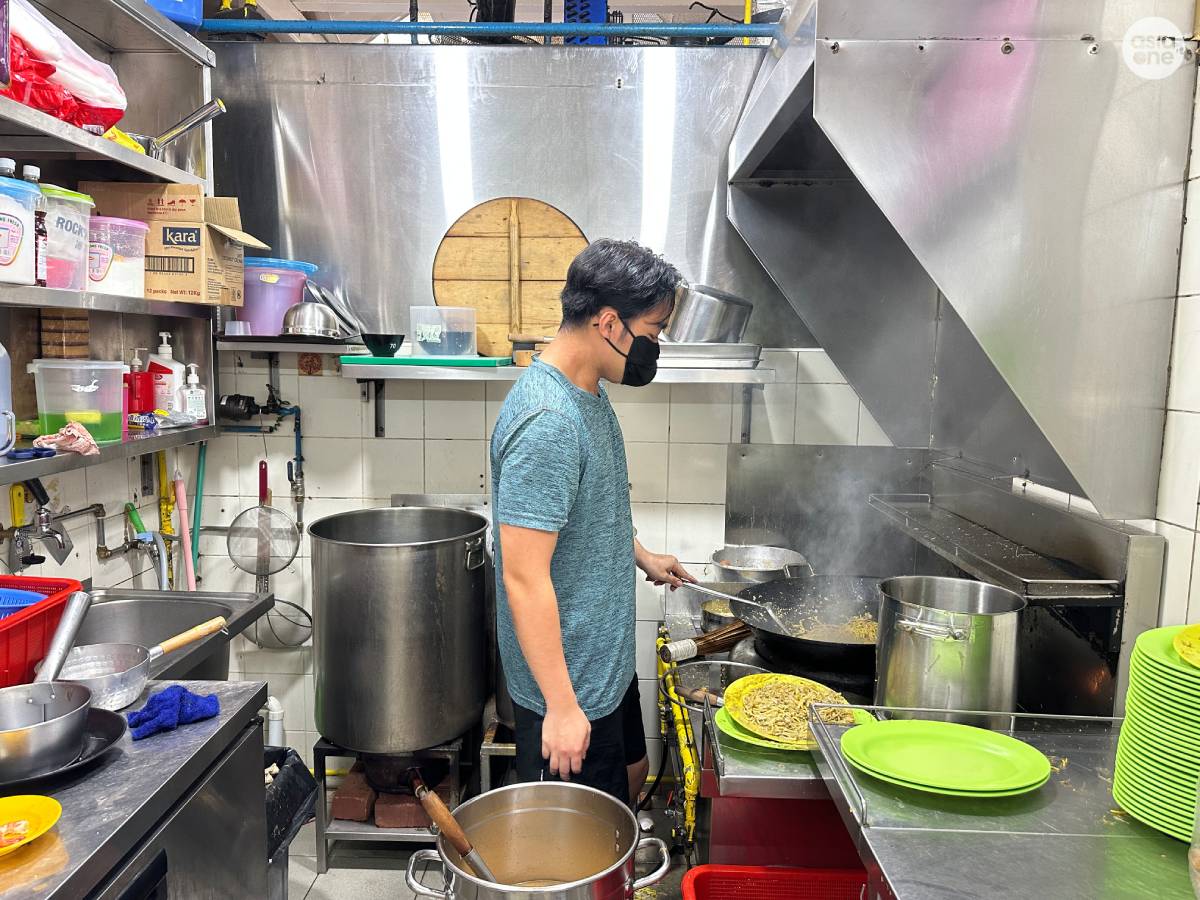
Despite the challenges, the experience has been extremely rewarding for Jing Herng because many people, including old friends, have come down to show their support.
"My family knows that I work almost every day, so I do not have much time to meet them. But they come down during the weekends and off days, with their partners and other family members, to support me. Seeing them makes me very happy," he shared.
His friends who knew about his passion for F&B were not shocked by his career choice but were surprised that he pulled it off.
"They are quite amazed because I took that leap of faith, and they've come down to support me. It's very nice to see all of them."
Jing Herng even managed to reconnect with people from different parts of his life.
"I've met people from my primary school, secondary school, junior college, army and university. They pop by and suddenly I'll see a familiar face. These are people that I haven't spoken to in almost a decade."
Jing Herng shared that recently, his primary school teacher paid him a visit too.
"She stays nearby. It was very heartwarming," he said.
Apart from support from family and loved ones, business has so far been good for Jing Herng, and he's had a good amount of footfall over the past few weeks.
"Thankfully business has been not too bad because of social media. People would post about my store on Facebook and a lot of people would come down and support me," he shared.
With more older hawkers retiring, Jing Herng hopes that more of the younger generation will take over.
"I think it is important for young people to take over the reins and continue this trade," he said.
Jing Herng also shared that some of his friends have even reached out to ask if they could join his team.
"I feel like if I can show them that they can do well in this line of work, they will be more assured that it's a feasible career path."
Jing Herng's advice to aspiring hawkers is simple: "Just do it."
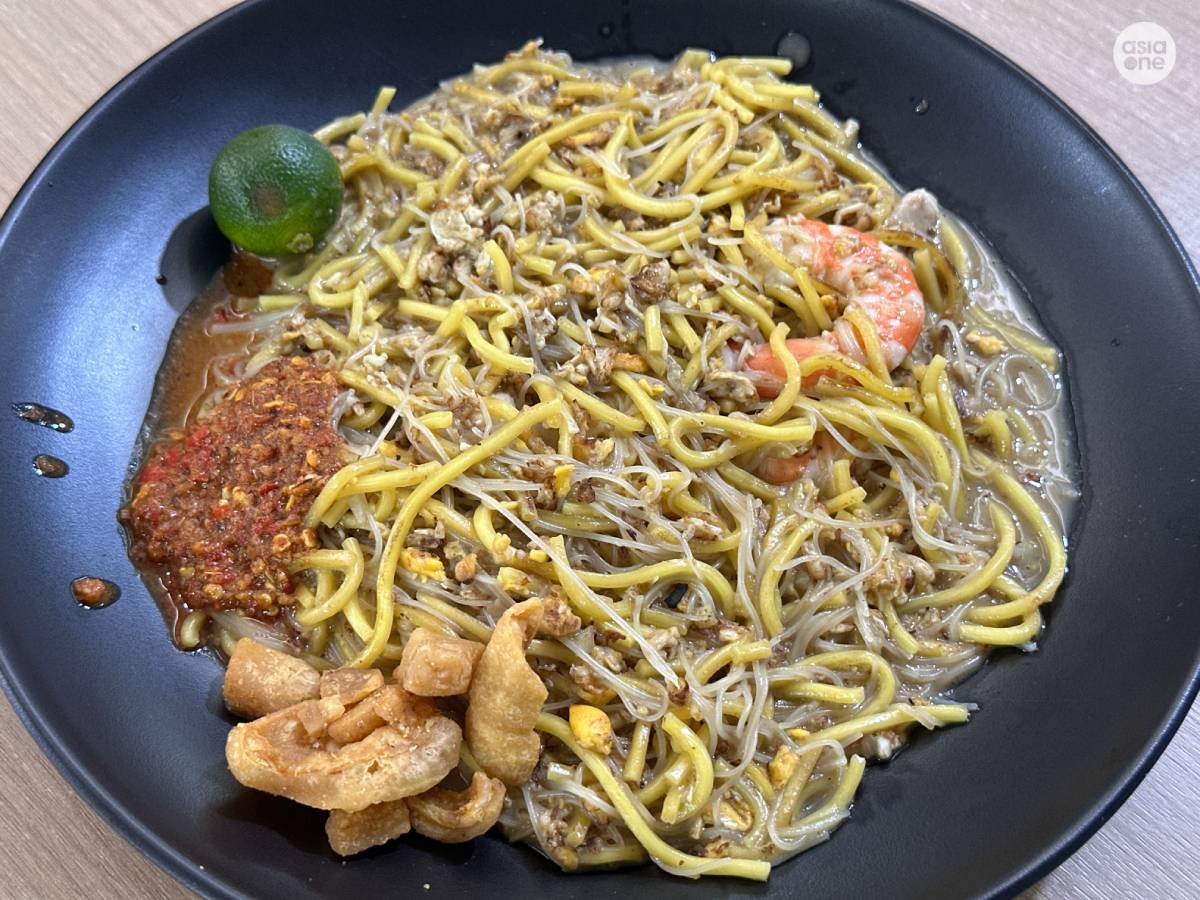
Herng Hao Chi Hokkien Mee sells its Hokkien mee in three sizes: Classic ($5), medium ($8) and large ($10).
But they also have a unique menu option called kosong mee, which costs $3.
Jing Herng explained that he created the kosong mee, which only comes with noodles, as a wallet-friendly option for the elderly.
He also plans to start a "pay it forward" initiative where diners can pay for someone else's meal.
This was inspired by an experience he had with a customer who visited during the stall's opening week.
"He ordered 30 packets of Hokkien mee to be delivered to his area for an event. On top of that, he paid for an additional 30 packets of Hokkien mee, which were to be distributed to anyone who wanted a meal, no questions asked," Jing Herng recounted.
Wanting to try Jing Herng's Hokkien mee for ourselves, we ordered a plate of the Classic Hokkien Mee.
We were immediately impressed by the generous portion. The dish was also loaded with ingredients such as prawns, squid and pork lard.
Unlike traditional Hokkien mee, Jing Herng's rendition doesn't come with bean sprouts or chives.
He also shared that he focuses heavily on the dish's wok hei, which he definitely nailed because every bite we had was smoky and packed with flavour.
Address: Lor 8 Toa Payoh, #01-52, Singapore 310210
Opening hours: Mon-Sun, 10.30am to 8.30pm
[[nid:735690]]
No part of this article can be reproduced without permission from AsiaOne.