

Inside a China 'fat camp': Singapore woman shares her 2-week experience

Singaporean interior designer Alexis Tan recently attended a 14-day fat camp in Shenzhen.
PHOTO: The Straits Times

SINGAPORE — In May 2024, Alexis Tan watched a clip of herself doing a television interview and could barely recognise herself.
“I knew I would look a bit different on television, but I didn’t expect to look that different. I looked so tired and lethargic,” says the 32-year-old Singaporean interior designer.
At her heaviest then, she weighed 90kg.
At 172cm tall, her body mass index (BMI) — a measure that uses height and weight to estimate total body fat — placed her in the obese category.
Tan says years of forgoing regular exercise and proper nutrition had taken a toll on her health.
The demands of her job often meant long hours, late nights and poor sleep, making it difficult to maintain healthy habits.
“Throughout my life, there were years when I was slimmer and years when I had gained some weight. In the years that I was bigger in size, people would ask me things like ‘Why are your clothes so big?’ or ‘Is your bag so big to match your body size?’” she says.
“The comments hurt, but I just laughed them off because I was so used to them.”
She first came across specialised weight-loss camps in China when an Australian content creator, TL Huang, posted about her personal experience on Instagram in November 2025.
At the time, Huang was attending a “fat camp” in Huizhou — a city to the east of Guangzhou — where she lost 6kg in 28 days.
Intrigued by the idea, Tan reached out to Huang to ask for more information and started researching such camps with her interior designer colleague, Chloe Chang.
A 23-year-old Malaysian, Chang was also interested in shedding a few kilos.
Chang, who is 158cm tall and weighed 68kg then, and 64kg now, says: “Over the years, I’ve tried many weight-loss methods — from slimming products to exercising to dieting — but maybe because I wasn’t very consistent, I didn’t see any lasting results.
“I’ve known of such camps for a while now because of social media and have been wanting to try attending one, so I thought why not try?”
After getting details about multiple camps over Chinese messaging platform WeChat, they signed up for a two-week stint at Chasing Dreams Weight Loss Training Camp in Dongguan, a city between Guangzhou and Shenzhen in China.
At around $800, it cost roughly 20 per cent more than their other camp options, primarily because it was conducted in an upscale hotel, with the choice of a 43 sq m room for each participant.
The cost covered all meals, daily training sessions and accommodation. Airfare and other incidentals were borne by participants.
Such weight-loss camps are proliferating across China, as obesity rates rise in the country.
Despite increasing national efforts to encourage weight loss, the prevalence of overweight and obesity among adults in China reached 57 per cent in 2023, according to a research paper published in the peer-reviewed journal ScienceDirect in March.
Without effective intervention, it is projected that up to 72 per cent of Chinese adults could be overweight or obese by 2035.
Obesity significantly increases the risk of serious medical conditions, including type 2 diabetes, cardiovascular disease, high blood pressure and stroke, according to the World Health Organisation.
Many of these Chinese “fat camps” — there are estimated to be at least 1,000 — promise to deliver swift weight-loss results within a couple of weeks through controlled daily routines, balanced meals and consistent exercise.
While the vast majority of participants are Chinese nationals, the number of international participants has been growing in recent years.
Social media has made such camps more discoverable.
China’s visa-free policy, rising popularity as a travel destination and relative affordability mean low entry barriers for those from abroad.
Mason Cong, head coach at Chasing Dreams Weight Loss Training Camp, tells The Straits Times there are three main types of people who sign up: those who want to lose weight, those who want to get stronger, and those who need a break and reset from unhealthy lifestyles for better mental and physical wellness.
Tan identifies most with the last group. She says: “Losing weight felt like a given. But I wanted to break out of my lifestyle routine in Singapore. I felt like I was working so much, I was neglecting my health and well-being.”
Most participants sign on for three to six months, while others enrol to adjust their lifestyles and stay onsite for just one month, Cong says.
Longer-term packages cost up to 9,880 yuan (S$1,870) a person for a month, while shorter stays are pro-rated accordingly.
Participants have to stay onsite for a minimum of one week.
The training camp sees around 1,000 participants a year on average.
He estimates that roughly 35 per cent are male and 65 per cent are female, ranging typically in age from 25 to 45.
Only about one per cent of camp participants are foreign nationals, he says.
The rest come from Guangdong province and other parts of China.
A growing market is Malaysia — in 2025, he saw a total of 10 participants from the country.
“We would love to reach more international audiences, but among our biggest hurdles is the language barrier. Currently, we conduct the full programme in Mandarin, and will need time to invest in English-speaking staff and training if we want to expand,” he says in Mandarin.
At the time of Tan’s participation, from May 23 to June 6, the camp had around 100 participants and nine personal trainers.
Participants were divided into five groups, with about 20 participants assigned to two trainers.
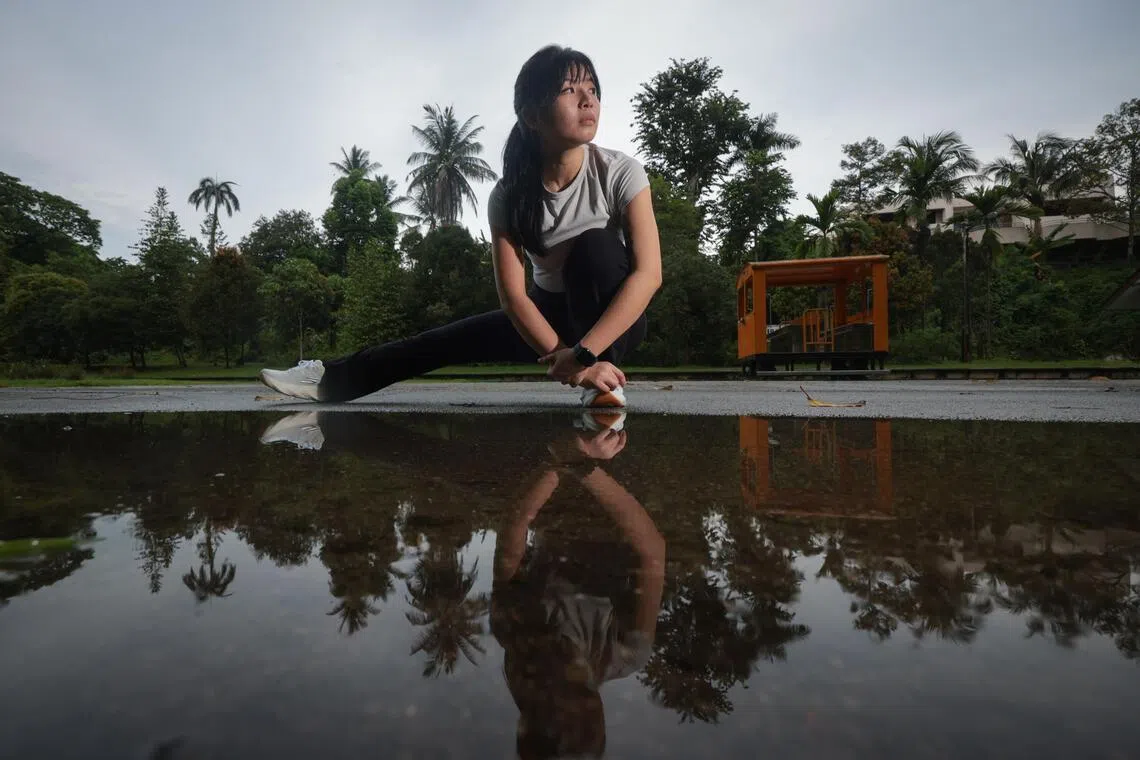
Tan says she was already working out regularly for six months before the camp, so its exercise regimen was not too physically daunting.
Her routine in Singapore included rock-climbing or jogging 3km to 5km at least three times a week.
Upon signing up, she had already reduced her weight from 90kg to 78kg through diet and exercise.
But she adds: “I didn’t want to spend my 30s in pain or having aches that would obstruct me from living my best life. I know I may not look obese, but I could be healthier. I needed to change my lifestyle.”
Her two-week programme, costing $800, included accommodation at five-star Jin Zheng He Hotel, all meals and training sessions.
She also spent an additional $400 on return flights from Singapore to Shenzhen on Shenzhen Air.


Meals were served at 8am, 11.30am and 5pm daily, and typically consisted of vegetables, eggs, lean proteins such as chicken or fish, soup or soya bean milk, and carbohydrates such as purple grain rice.
Hour-long workouts — including strength training, spin classes, aerobic step exercises and high intensity interval training — were conducted thrice a day at 9.30am, 3pm and 6.30pm.
At the end of each day, participants stepped onto the weighing scale to track their progress.
Those who fell short of their daily targets were encouraged to do an additional hour-long workout.
But this was not “compulsory”, says Cong.
While the programme was intensive, it was less regimented than Tan expected.
Instead of being driven by punishment, she says participants were motivated by a combination of accountability, peer support and visible progress everyone made each day.
“The trainers also understood that a short two-week programme had its limitations and that we, as foreigners, may not be used to their food or weather. So, they were definitely more lenient with us,” says Tan.
By the end of the camp, she lost 4kg, bringing her weight down to 74kg.
Medical practitioners were not stationed onsite, but Cong says all his trainers are certified and trained in first aid.
The nearest hospital is a 15-minute drive away.
“For clients with existing health problems, such as morbid obesity, heart problems or other issues, we will advise them to get a physical examination first and follow the doctor’s guidelines,” he says.
Weight-loss camps are often criticised for producing dramatic short-term results that can be difficult to sustain once participants return to normal routines.
Some of the initial weight loss, health experts note, may be attributed to reductions in water weight rather than body fat.
Tan Kok Kuan, who specialises in obesity management, says significant weight fluctuations can occur when participants adopt tightly controlled diets, particularly those that restrict carbohydrate intake.
“Carbohydrates draw water to themselves. So, once your carbohydrate intake drops, the water level in your body also drops and you can see a significant reduction in weight,” says the medical director of private practice Dr Tan Medical Centre.

He recommends that interested participants first consult a general practitioner (GP) about their overall health and weight-loss goals before embarking on a weight-loss camp.
He adds that while BMI is useful for broad screening, it cannot distinguish between weight from fat and weight from muscle mass, which can miscategorise fit and muscular individuals as “overweight” or “obese”.
For a more holistic assessment, doctors also take into account other biometric parameters such as waist circumference.
While weight loss is almost guaranteed in a camp setting, keeping the weight off afterwards is more challenging.
“In a very controlled environment, like a camp — where every calorie is accounted for and the patient really doesn’t have to live life in any other way — he or she can achieve this kind of lifestyle and lose weight,” says Tan.
“The problem is that a small imbalance in the calorie intake and output can lead to weight gain. Furthermore, our hormones naturally fight back against weight loss and push us to put the weight back on. It’s really an uphill battle. I’m not saying people can’t do it. I’m saying it’s going to be very difficult.”
Despite these caveats, Tan feels like there can be benefits to weight-loss camps.
If training camps impose the right regimen, it can be an educational experience for participants to learn healthy habits and understand nutrition better.
“These camps have a very artificial environment, which most of us probably cannot replicate in our daily lives. So, I hope participants get all this knowledge on calories and macronutrients and how to exercise in those weeks, and incorporate that into their lives,” he says.
Alvan Lim, head coach at fitness centre Oompf Fitness, recommends building an exercise routine prior, so the body can adapt to more intense activity levels.
“You need to prepare yourself mentally and physically, so it will help you to get through the camp more smoothly. Understanding your body and knowing its limits is also important, so if you experience any issues — like breathing difficulty or chest pain — you should let the trainers know,” he says.
Collectively, Alexis Tan’s social media videos about her journey have racked up over two million views.
Since her videos went viral, Cong has noted an increase in overseas interest.
From June 10 to 11, he received inquiries from at least 23 foreigners, the majority of which are likely from Singapore.
But Tan’s videos also have many viewers weighing in on the sustainability of such weight-loss methods in the comments section.
Taking all that on board, Tan reflects: “I think following the camp routine exactly is not possible because I don’t have as much time to work out in Singapore. But keeping this healthy mindset for long is possible.
“More than just losing weight, I wanted to make my health and well-being a priority. I think to that extent, I have succeeded.”
[[nid:737647]]
This article was first published in The Straits Times. Permission required for reproduction.