Motherboard audio is good enough for most people.
When it is not, the obvious upgrade is usually an external DAC or headphone amplifier: Easy to connect, easy to reach and easy to carry over to the next machine.
Creative's Sound Blaster AE-X takes the opposite route. It puts the DAC and amplifier inside the PC, alongside headphone tuning and Sound Blaster's gaming and entertainment processing.
The win is one less box plus less clutter. On the flip side, the controls disappear into software, and the audio hardware remains physically tied to a single Windows desktop.
A gaming sound card with audiophile ambitions
The AE-X occupies a rather unusual space.
It combines the headphone hardware and tuning features of an enthusiast desktop DAC with the sound processing expected of a Sound Blaster gaming card.
At its centre is an ESS ES9039Q2M Sabre DAC. It supports conventional high-resolution audio at up to 32-bit/384kHz, as well as DSD256, a more specialised high-resolution music format.
Creative quotes a dynamic range of up to 130dB and very low distortion — strong figures on paper. That said, the overall design matters more in the output.
The AE-X is built around stereo analogue output rather than the bank of separate 5.1 or 7.1 speaker connections traditionally associated with gaming sound cards.
Its rear headphone output is designed to cover a broad range of wired headphones, from sensitive in-ear monitors to high-impedance models.
It supports headphones rated from eight to 600 ohms and delivers up to 350mW at 32 ohms, with four power levels to suit different requirements.
The Creative Nexus app adds a 10-band parametric equaliser, which allows more precise sound adjustment than a basic bass-and-treble control. Its integrated AutoEQ profiles can also apply tuning intended for specific headphone models.
Other software features include virtual surround, Crystalizer, bass adjustment, Smart Volume and Dialog Plus. Scout Mode can emphasise positional sounds such as footsteps and weapon cues in games.
The internal format is both the point and the compromise
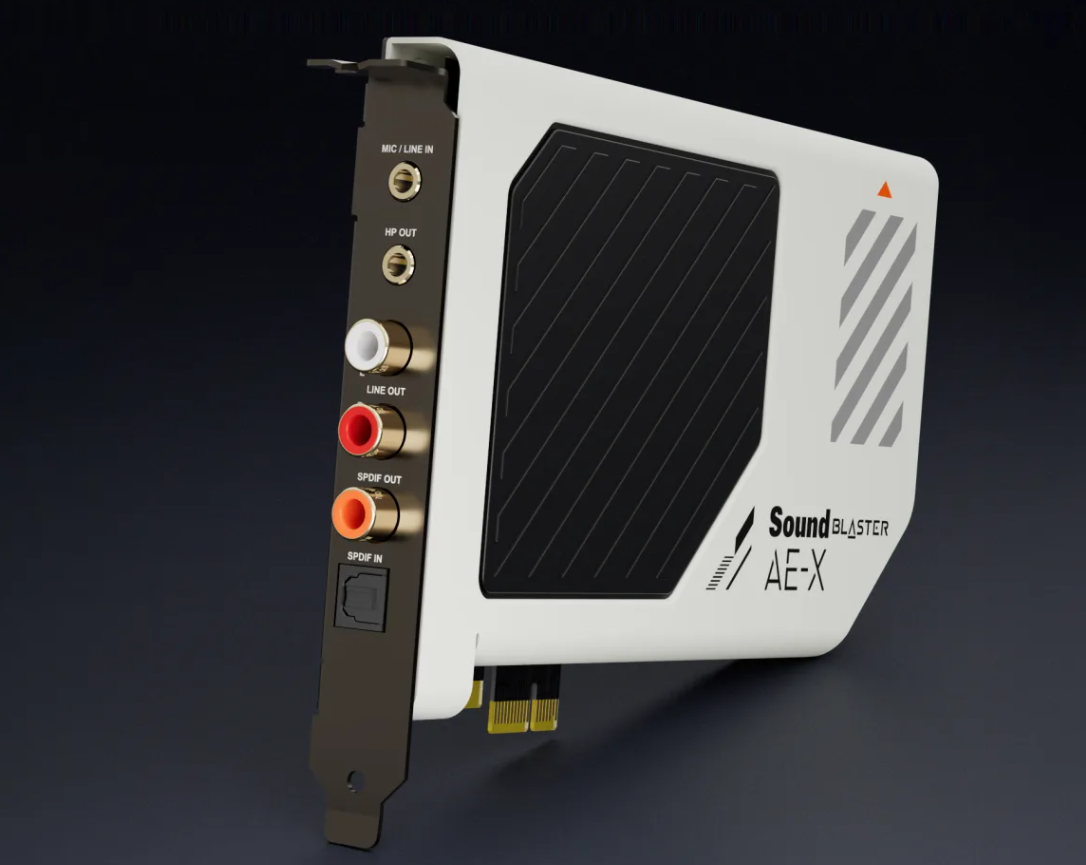
Inside the PC, the AE-X removes the external DAC and its USB lead from the desk.
Stereo RCA outputs can feed powered speakers or an amplifier, and the card does not occupy an external USB port. It does, of course, occupy a PCIe slot.
Creative also claims that the direct PCIe connection reduces latency, but provides no comparison showing whether this produces a practical gaming advantage over a good USB DAC.
Nearly every adjustment also happens through software. There is no physical volume knob, hardware game-and-chat balance or source selector within arm’s reach.
While the AE-X offers a convenient case-front headphone connection, it’s not without compromise. It is rated for 40 mW into 32 ohms, compared with 350 mW from the rear output. It also has a considerably higher output impedance. This means the front socket is less suitable for sensitive in-ear monitors and harder-to-drive headphones. So if the headphone amplifier is key for you, just bear in mind you may still end up running your cable to the back of the tower.
Creative’s own G8 is the awkward comparison
Ironically, the closest alternative comes from Creative itself.
The external Sound Blaster G8 is listed at SGD 239, making it SGD 30 cheaper than the AE-X. On paper, the audio performance is similar.
Both support playback up to 32-bit/384kHz, claim a 130dB dynamic range and use a low-impedance 1 Ω headphone output, with support for headphones rated up to 600 Ω.
The G8 does take up desk space and requires a USB cable. In return, it provides the conveniences expected of an external gaming DAC: A physical volume dial, headphone gain switch, GameVoice Mix, accessible headset connections, two USB-C audio inputs, HDMI ARC, and support for computers, consoles, and mobile devices.
It also includes Sound Blaster Acoustic Engine processing, Scout Mode and CrystalVoice microphone tools.
The AE-X counters with DSD256 support, ASIO 2.3, stereo RCA outputs and a parametric equaliser with integrated headphone profiles.
Whether that compensates for the G8’s physical controls, dual-USB mixing, HDMI ARC, and wider device support depends mainly on how badly the buyer wants the DAC off the desk.
Being installed beside a graphics card, motherboard and power supply also raises the usual question of electrical interference, though there is no evidence yet that this is a problem for the AE-X. But this is something you should take note of if you are interested.
Does the Sabre DAC change the answer?
The AE-X uses an ESS ES9039Q2M, while the G8 uses a Cirrus Logic CS43198. Both are respected modern DAC chips.
Audiophile shorthand sometimes describes Sabre converters as more detailed and Cirrus chips as smoother or more balanced. That said, the power supply, circuit design, analogue output stage and headphone amplifier can matter more than the badge on the converter.
Creative quotes similar headline performance for both products. The AE-X has a slightly lower claimed distortion figure, but whether that difference is audible remains to be seen.
On top of that, the AE-X’s DSD256 support is relevant mainly to listeners with music stored in that niche high-resolution format.
ASIO provides compatible music and audio production software with a more direct, low-latency path to the hardware.
Other features, such as AutoEQ, are convenient rather than exclusive. Creative’s implementation places headphone-specific correction profiles, the parametric equaliser and other device settings together inside Nexus.
External-DAC users can achieve something similar through the open-source AutoEq project and free Windows software such as Equaliser APO.
As such, Creative’s advantage is that the setup is already integrated into the card’s own software.
Who is the Sound Blaster AE-X actually for?
At $269, the AE-X will inevitably be measured against external products such as the G8. The sound card nevertheless serves a recognisable niche: an audiophile-leaning PC gamer with one Windows desktop and a dream.
That dream is simple. The same PC should drive good wired headphones, power a pair of powered desktop speakers, and retain Sound Blaster's surround, positional audio, and entertainment features — without another box or USB cable on the desk.
They do not need console support, easy switching between several devices or physical controls within arm's reach.
For them, keeping the DAC out of sight is a feature rather than an inconvenience.
[[nid:734405]]
This article was first published in Potions.sg.



